
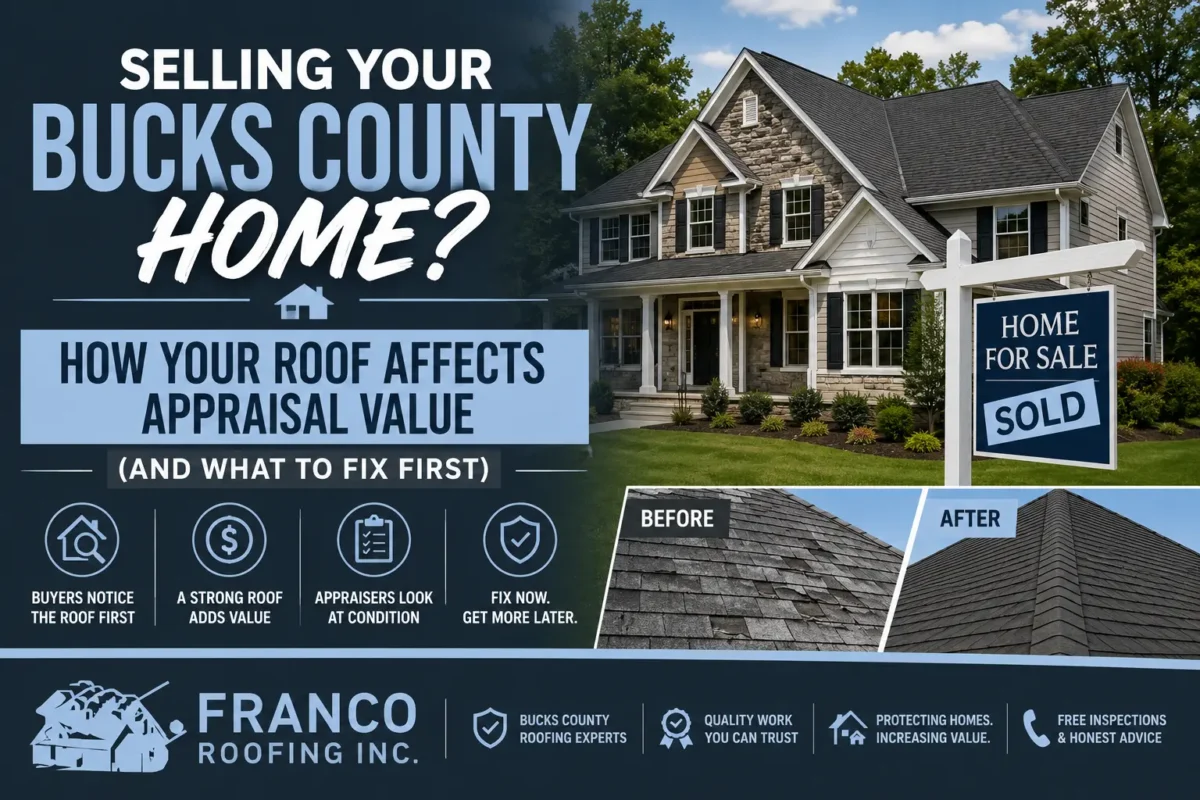
You’ve done the work. The kitchen has been updated, the landscaping is clean, and the interior is staged. Your Bucks County home is ready to show. Then the home inspector walks the property, gets on the roof, and flags issues you had no idea were there. The buyer’s lender orders an appraisal. The appraiser notes the roof’s condition. And suddenly a deal that felt solid is at risk.
This scenario plays out regularly in Bucks County and Montgomery County real estate transactions. The roof is the single exterior component that appraisers, home inspectors, and mortgage lenders scrutinize most closely—and the one that sellers most often underestimate when preparing a home for market. A roof in poor condition can reduce an appraised value directly, trigger lender-required repairs before closing, or give buyers negotiating leverage that costs far more than the repair itself would have.
Franco Roofing, Inc. has worked alongside Bucks County and Montgomery County homeowners preparing to sell for more than 54 years. We’ve seen what appraisers flag, what lenders require, and what buyers walk away from. We’ve also seen what a well-timed roof repair or targeted pre-listing fix does for a transaction. Here’s the practical guide every Bucks County seller should read before listing.
What You’ll Learn
- How appraisers and home inspectors evaluate roof condition in Bucks County transactions
- The specific roof issues that kill deals, trigger lender conditions, or reduce appraisal value
- How to assess your roof’s condition before the inspector does
- What to fix, what to disclose, and what’s not worth spending on before listing
- Why Bucks County sellers trust Franco Roofing for pre-listing inspections and repairs
- Frequently asked questions about roof condition and home sales in Pennsylvania
The Problem: Why Roof Condition Disrupts Bucks County Home Sales
Most sellers focus their pre-listing preparation on the interior—paint, flooring, fixtures, kitchen and bath updates. The roof, invisible from inside the home and difficult to assess from the ground, gets overlooked until the inspection report arrives. By then, the dynamic has shifted. The buyer has leverage, the timeline is compressed, and the seller is negotiating from a reactive position.
In Bucks County’s real estate market, where home prices are significant and buyers are often financing through conventional mortgages, FHA loans, or VA loans, roof condition is not a cosmetic issue. Lenders require that the property they’re financing be in a condition that protects their collateral. A roof flagged as “at end of useful life” or “with active leakage” by an appraiser can trigger a lender condition that halts the transaction until the issue is resolved—usually by the seller, under deadline pressure, at whatever price a contractor can offer on short notice.
Roof-related issues that commonly disrupt Bucks County home sales:
- Appraiser notation of roof “at or near end of useful life” reducing appraised value
- FHA or VA lender condition requiring roof repair or certification before closing
- Buyer inspection report flagging multiple roofing deficiencies and requesting repair credit
- Buyer walking away after roof inspection results reveal scope beyond their risk tolerance
- Title company requiring roof certification for certain sale structures
- Delayed closing while emergency repairs are arranged at compressed timelines and inflated cost
What Appraisers and Inspectors Actually Look For on Bucks County Roofs
Understanding what triggers an appraisal flag or inspection deficiency is the first step to preventing one. These are the conditions that most commonly affect home sale transactions involving Bucks County and Montgomery County properties.
1. Estimated Remaining Useful Life
Appraisers are trained to assess and document the estimated remaining useful life of major building components, including the roof. A standard asphalt shingle roof is considered to have a useful life of 20 to 25 years under Pennsylvania’s climate conditions. When an appraiser determines a roof has fewer than two to three years of remaining useful life, they will note this in the appraisal report—and depending on the loan type, this notation can trigger a lender condition requiring repair or replacement before the loan closes. For FHA and VA loans, the standard is particularly firm: the roof must be in a condition that will last at least two years. Conventional lenders use similar guidance, though with somewhat more discretion. Either way, a roof flagged as near end of life creates a transaction problem that the seller must resolve.
2. Visible Physical Deficiencies
Both appraisers and home inspectors document visible physical deficiencies during their assessments. These don’t require getting on the roof—many are identifiable from a thorough ground-level and attic inspection. The most commonly flagged conditions include:
- Missing, cracked, curling, or buckled shingles
- Lifted or separated flashing around chimneys, dormers, skylights, and vents
- Evidence of prior repairs that appear temporary or inadequate
- Sagging roof planes or ridge lines indicating decking or structural issues
- Active moss or algae growth across significant roof sections
- Evidence of water intrusion in the attic: staining, wet insulation, or mold growth
3. Number of Existing Shingle Layers
Pennsylvania building code permits a maximum of two layers of asphalt shingles. When a home already has two layers—common on Bucks County properties that had a re-roof in the 1990s or 2000s over an original layer—appraisers and inspectors will note this. The next roofing project must be a full tear-off regardless of the current layer’s condition. Some buyers and their lenders view a two-layer roof near the end of its life as a larger capital expense than a single-layer roof in the same condition, because the tear-off cost is included. This affects negotiating dynamics even when the roof isn’t technically flagged as deficient.
4. Premium Roof Conditions: Slate, Cedar, and Metal
Bucks County and Montgomery County have a substantial inventory of older homes with premium roofing materials—natural slate on Victorian and colonial properties in Doylestown, New Hope, and Newtown; cedar shake on mid-century and craftsman homes throughout Buckingham, Solebury, and Warminster; standing seam metal on agricultural conversions and custom builds. These materials add appraisal value when in good condition and create significant appraisal complexity when they’re not. A deteriorating natural slate roof on a $900,000 Doylestown property doesn’t just get flagged—it raises questions about replacement cost that most buyers and their lenders aren’t immediately equipped to answer. Pre-listing expert assessment of these roofing systems is especially valuable for sellers.
How to Assess Your Roof Before the Inspector Does
The most powerful position a seller can be in is knowing exactly what their roof’s condition is before listing—and having already addressed anything that would be flagged. Here’s a practical assessment approach for Bucks County homeowners preparing to sell.
- Start with the attic. Before anything else, inspect the attic with a flashlight. Look for water staining on decking and rafters, wet or compressed insulation, daylight visible through the roof boards, and any mold growth on wood surfaces. These are the conditions that most directly affect appraisal and lender decisions—and they’re discoverable without getting on the roof.
- Do a thorough ground-level inspection. Use binoculars to examine the full roof surface from all accessible ground positions. Note any missing, lifted, cracked, or curling shingles. Look at every roof transition—chimney, dormers, skylights, vent pipes—for flashing that appears to be separating or deteriorated. Look along the ridge line for sagging or irregularity.
- Check the gutters. Excessive granule accumulation in gutters is a direct indicator of shingle deterioration and will be noted by a thorough inspector. Granules that look like dark coarse sand collecting at downspout outlets indicate a shingle surface that is actively breaking down.
- Know your roof’s age. If you have permit records, contractor invoices, or prior inspection reports that document when the roof was last replaced, pull them. Appraisers will ask. If the roof is 18 years or older on asphalt, you are in the window where condition matters enormously. If it’s 22 or older, assume it will be flagged unless it’s in demonstrably excellent condition.
- Commission a pre-listing professional inspection. The most reliable approach is a pre-listing roof inspection from a specialist—not a general home inspector, but a roofing contractor with the expertise to assess condition accurately and provide a written report. This gives you a clear picture of what’s there, what needs attention, and what the buyer’s inspector will see. It also gives you time to act before listing rather than reacting during a transaction.
What to Fix, What to Disclose, and What to Leave Alone
Not every roof issue needs to be resolved before listing. The decision framework is straightforward: fix what will be flagged by an appraiser or lender, disclose what you know, and don’t over-invest in improvements that don’t return value. Here’s how to think through each category.
Fix Before Listing: High-Priority Issues
These are the conditions that consistently trigger lender conditions, appraisal flags, or buyer repair requests—and that are cost-effective to address before listing:
- Missing or significantly damaged shingles. Visible gaps or obviously damaged shingles are the easiest inspection flag to prevent. Individual shingle replacement on an otherwise sound roof is low cost and eliminates a deficiency that would appear in every inspection report.
- Active flashing failure. Separated or deteriorated flashing around chimneys, skylights, and vents is commonly flagged and relatively inexpensive to reseal or replace. Because flashing failure is the leading cause of persistent leaks, this will always attract attention from a thorough inspector.
- Evidence of active water intrusion. Any attic staining, wet insulation, or visible mold related to roofing must be addressed—both from a disclosure standpoint and because lenders will not close on a property with active moisture intrusion from the roof.
- Gutter and drainage problems. Gutters pulling away from the fascia, downspouts that discharge against the foundation, or gutters so full of debris they’re overflowing against the roofline will be noted. These are inexpensive to correct and meaningful to eliminate.
Evaluate Carefully: Major Work Before Listing
Full roof replacement before listing is a more nuanced decision. The return on a pre-listing roof replacement in Bucks County’s market typically comes in two forms: appraisal value support and buyer competition. A new roof on a home in the $400,000 to $900,000 price range—common in Doylestown, New Hope, Newtown, and Yardley—is a meaningful selling point that supports list price and removes a primary buyer objection. However, replacement only makes sense if the current roof would otherwise be flagged as near end of life or present a genuine lender condition.
In our experience working with sellers across Bucks County, the decision to replace before listing is usually correct when: the roof is 18 or more years old on asphalt; the home is priced above $400,000 where buyers expect move-in condition; or the roof is a premium material system (slate, cedar, metal) that requires specialist assessment and may generate buyer uncertainty without one. Franco Roofing can walk through this decision with you honestly—including cases where replacement is not the better financial call.
Disclose What You Know
Pennsylvania requires sellers to disclose known material defects on the Seller’s Disclosure form, including known roof issues. Attempting to conceal a known roof problem is a legal liability that does not go away at closing—Pennsylvania buyers have pursued sellers for roof-related non-disclosure after the fact. The practical and ethical approach is to disclose what you know and address what you can. A seller who discloses a repaired flashing issue and provides the contractor’s invoice is in a far stronger position than one whose inspection uncovers an undisclosed leak.
Why Bucks County Sellers Choose Franco Roofing for Pre-Listing Roof Work
Pre-listing roof work has a specific dynamic that differs from a standard replacement or repair project. The timeline is driven by the listing date, not the homeowner’s preference. The scope needs to be right—comprehensive enough to eliminate inspection flags without over-investing in improvements that don’t return value at sale. And the documentation matters: buyers, their agents, and their lenders will want to see invoices, warranty information, and confirmation of what was done.
Franco Roofing, Inc. is equipped to handle all of this. Our pre-listing inspection process produces a written assessment of the roof’s condition, identifies any deficiencies that would be flagged by a home inspector or appraiser, and gives sellers a clear recommendation on what to address and what to leave. We understand what Bucks County and Montgomery County appraisers are looking for because we’ve been working in this market since 1971.
For sellers with premium roofing systems—natural slate, cedar shake, standing seam metal—our specialist expertise is particularly valuable. A written assessment from Franco Roofing on the condition of a slate roof, including remaining life expectancy and any repairs completed, gives buyers and their lenders the informed basis they need to proceed with confidence. That documentation can be the difference between a buyer who is uncertain and one who is ready to close.
We are fully licensed in Pennsylvania (PA #PA018056) and New Jersey (NJ #13VH07058000), carry a $2,000,000 general liability policy and workers’ compensation, and back all repair and installation work with our 10-year workmanship warranty. That warranty is transferable documentation that travels with the home—a meaningful point of value for the buyer.
Frequently Asked Questions
Does roof condition affect home appraisal value in Bucks County?
Yes, directly. Appraisers assess and document the condition and estimated remaining useful life of the roof as part of every appraisal. A roof noted as at or near end of useful life can reduce appraised value and trigger lender conditions requiring repair before closing. For FHA and VA loans specifically, the roof must be certified to last at least two more years. Addressing flaggable conditions before listing avoids these complications entirely.
What roof issues will a home inspector flag during a Bucks County sale?
The most commonly flagged roofing deficiencies include missing or damaged shingles, active or past flashing failure at chimneys and penetrations, evidence of water intrusion in the attic, sagging roof planes, excessive granule loss indicating shingle wear, and roof age approaching or exceeding expected useful life. A pre-listing inspection from a roofing specialist identifies these issues before the buyer’s inspector does—giving the seller time to address them proactively.
Should I replace my roof before selling my Bucks County home?
It depends on the roof’s age and condition, the home’s price point, and the likely buyer profile. For homes priced above $400,000 with asphalt roofs 18 or more years old, pre-listing replacement often supports the list price and removes a primary buyer objection. For roofs with isolated, addressable deficiencies, targeted repair is usually the better investment. A Franco Roofing pre-listing assessment walks through this decision honestly—including cases where replacement is not the right call financially.
How much does a pre-listing roof inspection cost in Bucks County?
Franco Roofing provides free, no-obligation pre-listing roof inspections for Bucks County and Montgomery County homeowners. The inspection includes a written assessment of the roof’s condition, identification of any deficiencies that would be flagged by an appraiser or home inspector, and a clear recommendation on what to address before listing. There is no cost and no pressure to proceed with any particular scope of work.
Does a new roof increase home sale price in Bucks County?
A new roof typically returns 60 to 70 percent of its cost in appraised value—meaning a $12,000 asphalt replacement may add $7,000 to $8,000 in appraised value directly. The fuller return often comes indirectly: a new roof supports list price, reduces buyer negotiating leverage, eliminates a common contingency concern, and broadens the buyer pool by qualifying the home for FHA and VA financing without conditions. In Bucks County’s competitive market, that combination of benefits frequently justifies the investment.
Is Franco Roofing’s workmanship warranty transferable to the new buyer?
Yes. Franco Roofing’s 10-year workmanship warranty is transferable to the new homeowner and travels with the property at sale. This is meaningful documentation for buyers and their agents—it establishes that the roof was recently serviced by a licensed, insured specialist and carries a warranty that protects the new owner. Manufacturer material warranties are also transferable in most cases; we provide all documentation at project completion.
Do you serve the areas where most Bucks County home sales are concentrated?
Yes. Franco Roofing serves the full Bucks County real estate market, including Doylestown, New Hope, Newtown, Yardley, Buckingham, Solebury, Warminster, Warrington, Chalfont, and all surrounding communities. We also serve Montgomery County including Horsham, Lansdale, Blue Bell, Fort Washington, and Ambler, and Western New Jersey including Princeton and Hopewell. Call (215) 345-1828 to confirm service to your address and schedule a pre-listing inspection.
Next Steps: Get Ahead of the Inspection Before You List
The homeowners who navigate roofing issues most successfully in a sale are the ones who know what they’re dealing with before the listing goes live. A pre-listing roof inspection costs nothing, takes less than an hour, and gives you the information you need to make smart decisions—fix what matters, disclose what you know, and go into the transaction confident that the roof won’t become a problem at the table.
Key takeaways:
- Roof condition affects appraisal value directly and can trigger lender conditions that delay or derail closing
- The most common flagged issues—missing shingles, flashing failure, attic water intrusion—are preventable before listing
- A pre-listing specialist inspection gives you time to act rather than react
- Franco Roofing’s workmanship warranty is transferable to the buyer and travels with the home
Contact Franco Roofing, Inc. for a free pre-listing roof inspection:
- Doylestown: (215) 345-1828
- Newtown: (215) 860-1550
- Pipersville: (215) 766-0266
- Email: francoroofinginc@verizon.net
- Website: francoroofinginc.com
We respond within 24 hours and can typically schedule inspections within one week. Serving Bucks County, Montgomery County, and Western New Jersey since 1971.