
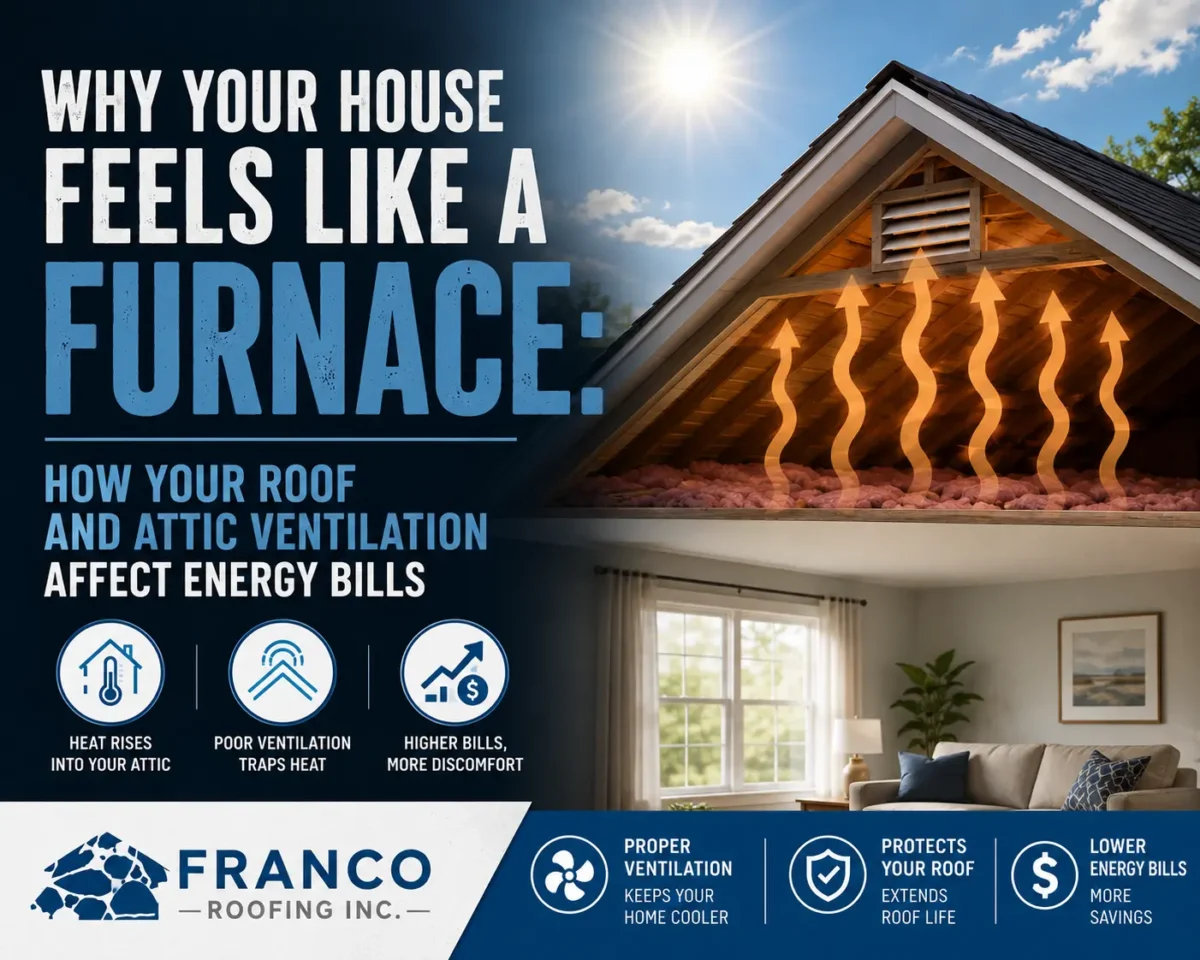
It’s July in Bucks County. Your air conditioning has been running since nine in the morning. The downstairs feels fine, but by afternoon the upstairs bedrooms are 10 degrees hotter than the thermostat setting, and the energy bill at the end of the month is significantly higher than it should be. You’ve had the HVAC serviced. You’ve added insulation. Nothing seems to fix it.
The problem almost certainly isn’t your air conditioner. It’s your roof system—specifically, your attic ventilation. When a residential roof lacks adequate ventilation, the attic becomes a heat reservoir. Outdoor temperatures in the 85 to 90 degree range produce attic temperatures of 130 to 150 degrees. That radiant heat transfers directly into the living space below, overpowers even a well-functioning AC system, and drives energy consumption through the roof—literally.
Most Bucks County and Montgomery County homeowners don’t realize their roof system plays a direct role in home comfort and energy efficiency. They think about the roof as weather protection—which it is—but not as a thermal management system, which it also is. Franco Roofing, Inc. has been installing and servicing roofing systems throughout Bucks County and Montgomery County since 1971. Attic ventilation problems are among the most consistently misdiagnosed comfort and energy issues we encounter. Here’s what every Pennsylvania homeowner should understand.
What You’ll Learn
- Why poor attic ventilation turns your upper floor into a furnace in summer
- The real causes of attic heat buildup in Bucks County and Montgomery County homes
- How to assess whether your roof ventilation system is working correctly
- What proper ventilation looks like—and the solutions that actually make a difference
- Why Bucks County homeowners trust Franco Roofing for ventilation and roofing solutions
- Frequently asked questions about attic ventilation and energy costs in Pennsylvania
What Is the Problem: How Attic Heat Overruns Your Living Space
The attic sits directly between your roof surface and your living space. When the roofing system is working correctly—with balanced intake and exhaust ventilation—outside air enters at the soffit (the underside of the roof overhang), flows through the attic, and exits at the ridge. This continuous airflow keeps attic temperatures close to outdoor ambient temperature and prevents heat accumulation.
When that ventilation is inadequate—because intake vents are blocked, exhaust capacity is insufficient, or the ventilation system was never properly designed in the first place—the attic becomes a sealed oven. Pennsylvania summer sun heats the dark roof surface to temperatures well above ambient. With nowhere to go, that heat radiates downward through the ceiling into the living space, where it works against every cooling system in the home.
Signs your home may have an attic ventilation problem:
- Upper floors consistently 8 to 15 degrees hotter than lower floors on warm days
- Air conditioning runs continuously on summer afternoons without reaching set temperature
- Energy bills spike in July and August disproportionately to outdoor temperature
- Attic feels noticeably hotter than outdoor temperature when you open the hatch
- Ice dams formed on the roof during the previous winter (a winter symptom of the same underlying problem)
- Shingles aging prematurely or blistering, particularly on south-facing roof sections
- Attic insulation that appears compressed, discolored, or damp despite no apparent roof leak
The Real Causes of Attic Heat Buildup in Pennsylvania Homes
Attic ventilation failures in Bucks County and Montgomery County homes have several root causes, and they often compound each other. Understanding which applies to your home determines the right solution.
1. Blocked or Insufficient Soffit Intake Vents
Proper attic ventilation is a balanced system: for every cubic foot of air exhausted at the ridge, an equivalent volume needs to enter at the soffit. When soffit vents are blocked—by insulation that has been pushed to the eaves, by bird nesting material, by debris accumulation, or by a renovation that inadvertently sealed them off—the exhaust vents at the ridge have nothing to draw through the system. The result is stagnant hot air sitting in the attic with nowhere to go. This is the single most common ventilation failure we see on Bucks County homes, and it’s routinely the cause of comfort problems that homeowners have been trying to solve for years with HVAC upgrades that address symptoms rather than the source.
2. Inadequate Exhaust Capacity at the Ridge
Many Bucks County and Montgomery County homes—particularly those built before the 1990s—were constructed with box vents or turbine vents that provided insufficient exhaust capacity for the attic volume. Building science understanding of ventilation ratios has advanced significantly since most of these homes were built, and the standard that applied when the roof was originally installed may not meet the net free area requirements that modern roofing best practices specify. Ridge vent systems—which run continuously along the full ridge line and exhaust hot air uniformly across the entire attic rather than from isolated points—are now the preferred solution for residential homes throughout Pennsylvania. A home that has never had a continuous ridge vent is a home that is likely underventilated.
3. Insulation Applied Directly Against the Roof Decking
Spray foam or blown insulation that has been applied directly to the underside of the roof decking—creating a “hot roof” or “conditioned attic” assembly—can work well when done intentionally and correctly. But when blown insulation migrates to the eaves and blocks the air channel between the soffit vent and the attic space, or when a previous contractor added insulation without understanding the ventilation system, the result is a roof cavity that can no longer breathe. This is a particularly common problem on older homes throughout Doylestown, New Hope, and other Bucks County communities where multiple owners have made incremental improvements over decades without a coherent building envelope strategy.
4. Mixing Ventilation Types—Defeating the System
A less obvious but significant cause of ventilation failure is mixing incompatible exhaust vent types on the same roof. When both ridge vents and powered attic fans—or ridge vents and box vents—exist on the same roof, they can short-circuit each other. A powered fan or box vent lower on the roof creates a low-pressure zone that draws air from the ridge vent rather than from the soffit, effectively reversing the intended airflow and pulling conditioned air from the living space into the attic. We see this configuration regularly on Bucks County homes where ventilation improvements have been made at different times without a systems-level review of what was already in place.
5. Dark Roofing Material Without Compensating Ventilation
Dark-colored asphalt shingles—charcoal, dark gray, or black—absorb significantly more solar energy than lighter alternatives. On a 90-degree Pennsylvania summer day, a dark asphalt surface can reach 160 to 180 degrees. This isn’t inherently a problem if the ventilation system is adequate to exhaust the resulting heat load. But on homes where ventilation was marginal to begin with, dark shingles push the thermal load beyond what the system can handle. Homes that upgraded to darker shingles during a re-roofing and then noticed increased summer heat and higher energy bills are often experiencing exactly this dynamic.
How to Assess Your Attic Ventilation Before Calling a Contractor
A meaningful ventilation assessment doesn’t require specialized equipment. Here’s what Bucks County and Montgomery County homeowners can check before engaging a roofing contractor.
- Check the attic temperature on a hot afternoon. On a day when outdoor temperatures are in the mid-80s or above, open your attic hatch mid-afternoon and note the heat level. If the attic feels dramatically hotter than outside—and especially if it feels hotter than 110 to 120 degrees based on your own sense—you have a ventilation problem. A properly ventilated attic should track within 10 to 20 degrees of outdoor ambient temperature.
- Inspect the soffit vents from inside the attic. With a flashlight, look toward the eaves from inside the attic. You should see daylight coming through the soffit vents. If you cannot see daylight—or if the channel between the top of the wall and the roof decking is packed solid with insulation—your intake is blocked. Blocked intake is the most common cause of ventilation failure and is fixable without major roofing work.
- Walk the exterior and identify exhaust vent locations. Note what types of exhaust vents are on the roof and where they are located. A continuous ridge vent running along the peak is the most effective configuration. Box vents, turbine vents, or power fans on the upper roof slope are less efficient and may indicate a system that has been supplemented over time rather than properly designed. If you see both a ridge vent and other exhaust vents, this is worth discussing with a roofing specialist.
- Check for ice dam history. Ice dams are a winter symptom of the same ventilation problem that causes summer overheating. If your home has had ice dams in recent winters, the underlying cause is almost certainly inadequate attic ventilation allowing heat from the living space to escape into the attic and melt snow unevenly. Solving the ventilation problem eliminates both the summer and winter symptoms.
- Examine shingle condition on south-facing sections. Premature shingle blistering, cracking, or granule loss concentrated on south- and west-facing roof sections—which receive the most direct sun exposure—can indicate that attic heat is being trapped and accelerating degradation from below. Shingles are rated for specific temperature ranges during installation; sustained attic overheating shortens their effective lifespan.
What Proper Roof Ventilation Looks Like—and How to Fix the Problem
The 1-to-150 Ventilation Standard
The industry standard for residential attic ventilation is one square foot of net free ventilation area for every 150 square feet of attic floor space, split evenly between intake and exhaust (some codes allow 1:300 with a vapor barrier, but 1:150 is the stronger recommendation for Pennsylvania’s climate). For a 1,500-square-foot attic, that means 10 square feet of net free ventilation—five at the soffit, five at the ridge. Most older Bucks County homes fall well short of this standard.
Installing or Clearing Soffit Vents
If soffit vents are blocked by insulation, the most cost-effective fix is installing rafter baffles—cardboard or foam channels that maintain an open air path from the soffit vent to the attic space above the insulation. This is a relatively simple intervention that restores intake airflow without requiring roofing work. If soffit vents are absent or inadequate, continuous perforated soffit panels along the full eave length provide the most uniform intake and are installed as part of a roofing or soffit replacement project.
Upgrading to a Continuous Ridge Vent System
For homes with inadequate or mixed exhaust ventilation, installing a continuous ridge vent is the most impactful single improvement. Ridge vents run along the full peak of the roof and exhaust hot air uniformly across the entire attic length, taking advantage of natural convection and wind-induced negative pressure. When paired with unobstructed soffit intake, a ridge vent system creates the balanced airflow that keeps attic temperatures manageable. Franco Roofing installs ridge vent systems as part of new roof installations and as standalone upgrades on existing roofs where the current ventilation configuration is inadequate.
Addressing Ventilation at Roof Replacement Time
The best time to address attic ventilation is during a roof replacement, when the full roofing system is being evaluated and modified anyway. Franco Roofing’s installation process includes a ventilation assessment as part of every replacement project. We verify that intake and exhaust capacity meets the 1:150 standard for the attic volume, identify any blocking or configuration issues, and recommend appropriate upgrades. A homeowner who replaces their roof without addressing ventilation is installing new material on a system that will continue to underperform thermally and may shorten the new shingles’ lifespan through sustained heat exposure.
What Not to Do: Power Attic Ventilators
Powered attic fans—electric or solar—are frequently marketed as the solution to attic heat problems, and they are frequently the wrong choice. When intake ventilation is inadequate, a powered fan doesn’t draw outside air through the attic—it draws conditioned air from the living space through ceiling gaps and light fixtures, pulling your cooled air into the attic and exhausting it outside. This increases air conditioning load rather than reducing it. In our 54 years working on Bucks County and Montgomery County homes, we have found power attic fans to be a consistent source of wasted energy and unresolved comfort problems. Passive balanced ventilation—adequate soffit intake paired with a continuous ridge vent—outperforms powered fans in virtually every residential application.
Why Bucks County Homeowners Trust Franco Roofing for Ventilation and Roofing Solutions
Attic ventilation is not a standalone product—it’s a roofing system function that requires expertise in how roofing components interact. A contractor who installs ridge vents without evaluating soffit intake, or who replaces shingles without assessing the ventilation adequacy beneath them, is solving part of a system problem. Franco Roofing evaluates the complete roofing system: material, underlayment, ventilation, flashings, and the relationship between all of them.
In 54 years serving Bucks County and Montgomery County homes—from historic Victorians in Doylestown and New Hope to newer construction in Warminster, Horsham, and Blue Bell—we’ve seen every configuration of residential roofing system and ventilation assembly. Michael Procaccino and our team of 10 specialized installers bring that depth of experience to every project. When we identify a ventilation problem, we explain what it is, why it matters, and what the options are—not just what to sell.
Franco Roofing is fully licensed in Pennsylvania (PA #PA018056) and New Jersey (NJ #13VH07058000), carries a $2,000,000 general liability policy and workers’ compensation, and backs all installation work with our 10-year workmanship warranty. 80% of our business comes from referrals. That model depends on giving homeowners honest assessments and delivering results that hold up—not on recommending work that isn’t needed.
Frequently Asked Questions
How do I know if my attic ventilation is the reason my house is so hot in summer?
The most reliable indicator is attic temperature on a hot afternoon. Open your attic hatch when outdoor temperatures are in the mid-80s and note how hot the attic feels. A properly ventilated attic should track within 10 to 20 degrees of outdoor temperature. If it feels dramatically hotter than outside, or if you can see that daylight isn’t reaching through the soffit vents into the attic interior, inadequate ventilation is almost certainly contributing to your comfort and energy problems.
How much can better attic ventilation reduce my energy bills in Pennsylvania?
The impact varies based on the severity of the current problem, the home’s construction, and the HVAC system. Homes with significantly underventilated attics in Pennsylvania’s climate can see meaningful reductions in summer cooling costs—industry estimates typically range from 10 to 15 percent reduction in cooling energy consumption when ventilation is brought into proper balance. The more meaningful result for most Bucks County homeowners is restored comfort on the upper floor without upgrading the AC system.
Does poor attic ventilation damage my roof?
Yes, in two significant ways. In summer, sustained attic heat above manufacturer specifications causes shingle blistering, accelerated granule loss, and premature aging—particularly on south- and west-facing sections. In winter, inadequate ventilation allows heat from the living space to warm the roof deck unevenly, causing snow melt and ice dam formation that forces water under shingles. Proper ventilation protects both the shingles and the underlying structure and is specifically required by most shingle manufacturers to maintain warranty validity.
What is the difference between a ridge vent and a box vent or power fan?
A continuous ridge vent runs the full length of the roof peak and exhausts hot air uniformly across the entire attic using passive convection and wind effect. Box vents are fixed exhaust points installed at intervals on the upper roof surface—less efficient and more prone to short-circuiting the intake flow. Power fans are motorized exhaust units that can pull conditioned air from the living space into the attic when intake ventilation is insufficient—often worsening energy consumption rather than improving it. For most Bucks County homes, a continuous ridge vent paired with unobstructed soffit intake is the most effective and durable solution.
Can attic ventilation be improved without replacing the roof?
In many cases, yes. If soffit vents are blocked by insulation, installing rafter baffles to restore the air channel is a low-cost intervention that doesn’t require roofing work. If exhaust capacity is inadequate, additional box vents or a continuous ridge vent can be added to an existing roof. However, the most comprehensive and cost-effective time to address ventilation is during a roof replacement, when the roofing system is already open and being modified. Franco Roofing will assess your specific situation and recommend the approach that makes sense for your home’s condition and timeline.
How much does attic ventilation improvement cost in Bucks County?
Cost depends on the scope of the work—whether it involves clearing blocked intake, adding exhaust vents, or installing a full continuous ridge vent system as part of a broader roofing project. Franco Roofing provides free, no-obligation assessments and written estimates for all ventilation-related work throughout Bucks County and Montgomery County. We explain what’s needed, why, and what it costs before any work begins.
Does Franco Roofing assess ventilation as part of a roof replacement?
Yes, always. Every Franco Roofing replacement project includes a ventilation assessment as a standard component. We verify that intake and exhaust capacity meets the 1:150 ventilation ratio standard for the attic volume, identify any blocking or configuration problems, and recommend appropriate upgrades. A new roof installed without addressing underlying ventilation problems will underperform thermally and may void shingle manufacturer warranties that require adequate ventilation as a condition of coverage.
Next Steps: Fix the System, Not Just the Symptoms
If your upper floor is uncomfortably hot in summer, your energy bills spike in July and August, or you’ve had ice dams in recent winters, the root cause is likely in your attic—not your HVAC. A roofing specialist who understands ventilation systems can identify the problem accurately and give you a clear, cost-effective path to fixing it.
Key takeaways:
- Blocked soffit intake is the most common ventilation failure on Bucks County homes—and one of the most fixable
- Passive balanced ventilation (soffit intake + continuous ridge vent) outperforms power fans in nearly every residential application
- Poor ventilation shortens shingle lifespan and can void manufacturer warranties
- Roof replacement is the best opportunity to address ventilation comprehensively—but improvements can often be made without full replacement
Contact Franco Roofing, Inc. for a free ventilation assessment and estimate:
- Doylestown: (215) 345-1828
- Newtown: (215) 860-1550
- Pipersville: (215) 766-0266
- Email: francoroofinginc@verizon.net
- Website: francoroofinginc.com
We respond within 24 hours and can typically schedule consultations within one week. Serving Bucks County, Montgomery County, and Western New Jersey since 1971.
One thought on “Why Your House Feels Like a Furnace: How Your Roof and Attic Ventilation Affect Energy Bills”
Comments are closed.