
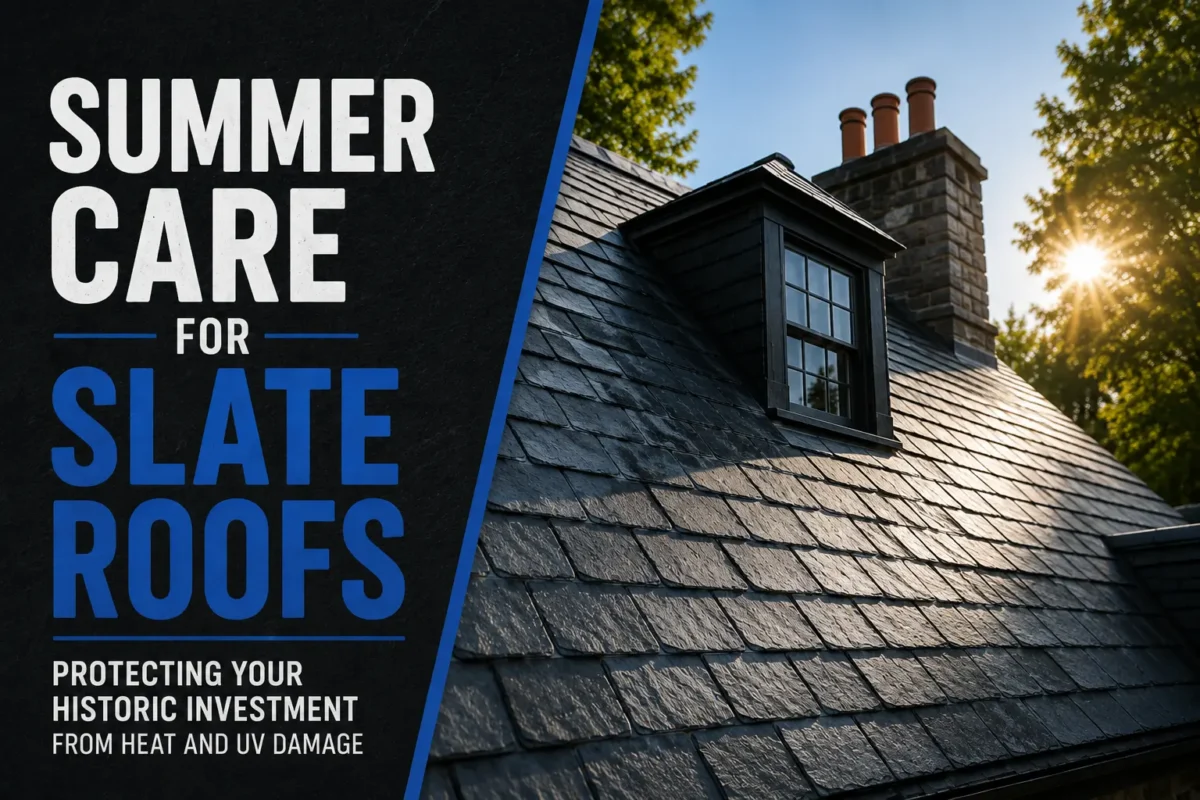
A natural slate roof is one of the most durable and beautiful roofing systems ever developed. On the historic homes of Doylestown, New Hope, Newtown, and throughout Bucks County’s older neighborhoods, slate roofs installed in the early to mid-1900s are still performing—protecting families and preserving the architectural character that makes these properties worth owning in the first place. A well-maintained slate roof can last 75 to 150 years. That kind of longevity doesn’t happen by accident.
Summer presents a specific set of challenges for slate roofing systems. Intense UV radiation, prolonged heat exposure, thermal expansion and contraction through temperature swings, and summer thunderstorm activity all interact with slate’s natural mineral structure, its fastening system, and the flashings and underlayment that support it. The damage that results is rarely dramatic. It accumulates quietly: a fastener loosens here, a flashing sealant cracks there, a slate shifts by a quarter inch. Individually, none of these is a crisis. Collectively, over a few seasons of inattention, they become the reason a 90-year-old slate roof that should have lasted another 30 years ends up needing replacement.
Franco Roofing, Inc. has been installing, repairing, and maintaining slate roofs throughout Bucks County, Montgomery County, and Western New Jersey since 1971. Slate is our signature specialty—not a service we offer alongside everything else, but a material system we have spent more than 50 years mastering. Here is what that experience tells us every slate roof owner needs to know going into summer.
What You’ll Learn
- How summer heat and UV exposure affect natural slate roofing systems
- The real causes of premature slate roof deterioration in Pennsylvania’s summer climate
- How to assess your slate roof’s condition before and after summer storm season
- What summer maintenance actually involves for a slate roofing system
- Why Bucks County historic property owners trust Franco Roofing for slate care
- Frequently asked questions about slate roof maintenance in Pennsylvania
What Makes Summer the Critical Season for Slate Roof Maintenance
Natural slate is a metamorphic rock—formed under intense geological pressure over millions of years—and it is genuinely one of the most durable roofing materials available. But durable does not mean impervious. Slate is a mineral with a layered crystalline structure, and that structure responds to environmental stresses in predictable ways. Heat and UV radiation are among the most consistent stressors a Pennsylvania slate roof faces, and summer delivers both in concentrated form.
Beyond the slate itself, a slate roofing system includes copper or steel fasteners, lead or copper flashings, an underlayment layer, and in many cases ridge and hip caps that are more vulnerable to summer conditions than the field slate. The lifespan of the system is often determined not by the slate tiles themselves—which may be perfectly sound—but by the condition of these supporting components. Summer is when fastener failure, flashing deterioration, and underlayment stress show their first indicators, and when a skilled specialist can catch them before they become structural problems.
Warning signs that your slate roof may need summer attention:
- Individual slates that appear shifted, lifted at one edge, or visibly out of alignment from the ground
- Slate fragments or whole tiles visible in gutters or on the ground after summer storms
- Dark staining or rust streaks running down from fastener locations on the roof surface
- Lead or copper flashing that appears lifted, wrinkled, or separated at transitions
- Ridge or hip cap slates that appear loose, cracked, or missing
- Any interior ceiling staining following summer thunderstorms
- Slates that sound hollow rather than solid when tapped (a test for a professional, not a DIY exercise)
The Real Causes of Summer Slate Roof Deterioration in Pennsylvania
Understanding what actually causes slate roof problems in Pennsylvania’s summer climate is the foundation of an effective maintenance approach. These are the mechanisms we encounter most consistently across Bucks County, Montgomery County, and Western New Jersey properties.
1. Fastener Corrosion and Failure
The slates themselves are held in place by fasteners—traditionally copper nails on quality installations, sometimes steel or aluminum on lower-grade work or repairs done over the decades. Steel and aluminum fasteners corrode in Pennsylvania’s climate, and that corrosion accelerates under summer heat. As a fastener oxidizes, it expands slightly within the pre-drilled hole in the slate, eventually cracking the slate from within—a failure mode called nail sickness. On historic Bucks County properties with roofs installed 60 to 100 years ago, fastener condition is often the primary determinant of remaining roof life. A slate that has lasted a century can be lost to a corroded nail that costs pennies to replace when caught early. Summer’s thermal cycling—heating and cooling through the day—accelerates the expansion and contraction that works loose fasteners free.
2. Flashing Deterioration Under Thermal Stress
The flashings that seal transitions around chimneys, dormers, skylights, and roof valleys are among the most thermally stressed components of any roofing system. Lead flashings—the traditional and still superior choice for slate roofing—expand and contract with temperature changes at a different rate than the surrounding slate and masonry. Over decades of Pennsylvania summers, this differential movement fatigues the lead at bends and edges, eventually creating micro-cracks through which water infiltrates. Copper flashings are more durable but are not immune to the same long-term fatigue process. Sealants used in flashing repairs—caulks, mastics, and roofing cements—degrade significantly faster than the metal itself under UV exposure. A flashing sealant applied in acceptable condition in spring can be cracked and failing by late summer on a south-facing roof surface receiving full sun exposure.
3. Underlayment Degradation in Older Slate Systems
Historic slate roofs on Bucks County properties were installed over a variety of underlayment materials—red rosin paper, felt underlayment, and in some cases no underlayment at all on very early installations. These materials have finite lifespans. When the underlayment beneath a slate field begins to deteriorate, it loses its ability to function as a secondary water barrier—meaning the slate alone is carrying the full waterproofing burden. A single loose or missing slate that would have been inconsequential over intact underlayment becomes a direct water pathway into the structure. Summer heat accelerates underlayment degradation, particularly on south- and west-facing slopes where roof deck temperatures are highest. On roofs where the slate itself remains in good condition but the underlayment has reached end of life, this is often the deciding factor in whether the existing slate can be retained through a re-underlayment process or whether replacement is necessary.
4. Thermal Delamination of Soft-Vein and Lower-Grade Slate
Not all natural slate performs equally over time. Hard-vein slates—quarried primarily from Vermont and Virginia—are among the most durable roofing materials on earth, with tested lifespans exceeding 100 years. Softer slates from some Pennsylvania and New York quarries have shorter expected lifespans and are more susceptible to thermal delamination: the gradual separation of the slate along its natural layering planes under repeated heat-and-cool cycling. This process produces slates that flake, spall, or break transversely—creating irregular edges that no longer shed water cleanly. On Bucks County homes with roofs installed between 1920 and 1960, soft-vein slate delamination is a common finding on summer inspections. The extent of delamination across the field determines whether targeted replacement of affected tiles or full re-roofing is the appropriate response.
5. Summer Storm Impact and Wind Uplift
Pennsylvania’s summer thunderstorm season delivers wind, hail, and debris impact to roof surfaces regularly. Slate’s mass and hardness make it significantly more resistant to hail damage than asphalt shingles, but it is not invulnerable. Hail large enough to fracture slate—generally above three-quarters of an inch—can crack tiles at the nail hole, creating a failure that may not produce an immediate interior leak but compromises the tile’s integrity and water-shedding ability. Wind uplift on slates that are already loose due to fastener wear is another significant summer risk. A slate that has been gradually working loose through spring will often come free entirely in the first major summer storm. Post-storm inspection is a standard part of responsible slate roof ownership in Bucks County.
How to Assess Your Slate Roof’s Condition This Summer
Meaningful slate roof assessment requires both a ground-level visual inspection that owners can perform and a professional close-up examination that only a qualified slate specialist should conduct. Here’s how to approach both.
- Ground-level binocular inspection. From multiple positions around the property, examine the full roof surface with binoculars. Look for slates that appear shifted out of their coursing, lifted at one edge, cracked across the face, or with a visible gap where an adjacent tile is missing. Pay particular attention to ridge and hip caps—these are among the first components to show loosening. Note any rust streaking on the slate surface, which indicates a corroding steel fastener beneath.
- Inspect gutters and ground after storms. After any significant summer storm, walk the perimeter and check gutters and the ground around the foundation for slate fragments or complete tiles. Whole slates in good condition that have fallen are typically fastener failures—the slate itself is reusable and the repair is straightforward. Fragmented or flaking slate in the gutters indicates delamination across part of the field.
- Check the attic after thunderstorms. Within 24 hours of a summer storm, inspect the attic with a flashlight for any new moisture staining on the decking or rafters. Slate systems that are performing as designed produce no interior moisture. Any new staining pinpoints a location for closer professional investigation.
- Note chimney and dormer flashing from ground level. Look closely at every roof transition—chimney, dormer walls, skylights, valleys—for flashing that appears lifted, wrinkled, or pulled away from the slate surface. Lead flashing in good condition lies flat against the surrounding material. Flashing that has developed a raised edge or visible gap at any point is allowing water to run behind it.
- Know your roof’s age and slate type. If you have documentation of when your slate roof was installed and any repair history, pull it before engaging a contractor. Knowing whether the original installation used hard-vein or soft-vein slate—and the approximate age of the underlayment—significantly informs the maintenance strategy. A 70-year-old Vermont slate roof in Doylestown is a very different asset than a 70-year-old Pennsylvania soft slate roof in the same neighborhood.
Do not walk your slate roof without a specialist present. Slate roofs require specific equipment, technique, and weight distribution knowledge to traverse without causing damage. A single misplaced step can crack multiple tiles and create new leak points. This is a consistent source of damage we see on Bucks County properties where well-intentioned owners or unqualified contractors have attempted roof walks without slate-specific training.
What Summer Slate Roof Maintenance Actually Involves
Annual Professional Inspection
The foundation of slate roof longevity is regular professional inspection by a contractor with genuine slate expertise. Franco Roofing conducts close-access inspections of the full slate field, fastener condition, flashing integrity, ridge and hip cap stability, and underlayment condition where assessable from above. We document findings with specific locations and provide a clear assessment of what needs immediate attention, what should be monitored, and what the broader system’s remaining lifespan looks like. An annual or biennial inspection on a historic Bucks County slate roof is not a luxury—it is the practice that determines whether the roof lasts another 30 years or needs replacement in 10.
Slate Replacement and Fastener Repair
Individual slates that are cracked, delaminating, or have been lost to fastener failure are replaced as part of routine maintenance. This is skilled work that requires matching the replacement slate to the existing field in size, thickness, and material—visually and functionally. Franco Roofing maintains relationships with suppliers of both domestic and imported natural slate, including the specific grades used on historic Bucks County properties. A replacement slate that doesn’t match the original in thickness or coursing disrupts the water-shedding pattern and creates a differential that accelerates adjacent tile wear.
Flashing Repair and Replacement
Failing flashing on a slate roof is addressed by a specialist who understands how lead and copper flashings are integrated with the surrounding slate coursing. On historic properties, this often involves removing multiple courses of slate above the flashing, replacing the flashing in kind, and relaying the slate correctly. A roofing generalist who patches deteriorated flashing with caulk or roofing mastic is buying time—not solving the problem. Those temporary repairs typically last one to three seasons before failing again, while a correctly executed lead or copper flashing replacement on a slate roof is a multi-decade solution.
Post-Storm Response
After any significant summer thunderstorm—particularly those with wind over 40 mph or hail—a prompt professional inspection is appropriate if ground-level or attic observation has identified any concern. Slates that have been dislodged but not fallen can often be re-secured. Cracked slates that remain in place can be replaced before the next rain event. The window between a storm and the next significant rainfall is the optimal time to address any impact damage before water infiltration causes secondary damage to decking and interior structure.
When Re-Roofing Is the Right Answer
Not every aging slate roof warrants continued repair. When the percentage of cracked or failing slates across the field exceeds 20 to 25 percent, when the underlayment has reached end of life and can no longer function as a secondary barrier, or when fastener corrosion is widespread rather than isolated, full re-roofing is the more economical decision. Franco Roofing approaches this honestly. We have re-roofed slate systems where repair was no longer cost-effective, and we have maintained others that skeptics said were past their useful life. The recommendation depends on what the roof actually shows—not on a predetermined conclusion.
Why Bucks County Historic Property Owners Trust Franco Roofing for Slate
Slate roofing is a specialty. That word gets used loosely in the roofing industry—many contractors will claim they “do slate”—but genuine slate expertise means understanding the material at a level that comes only from years of hands-on work. It means knowing the difference between hard-vein and soft-vein slate by look and feel. It means knowing how to walk a slate roof without breaking tiles. It means understanding how lead flashing integrates with a historic slate field and what proper re-laying technique looks like. It means having supplier relationships to source matching slate for a 100-year-old Doylestown Victorian.
Franco Roofing has built that expertise across more than 50 years of slate work throughout Bucks County, Montgomery County, and Western New Jersey. Franco Procaccino established the company’s reputation in slate and cedar in 1971. Michael Procaccino, with 25+ years of direct experience, has continued that work on some of the most significant historic properties in the region—New Hope, Doylestown, Solebury, Buckingham, Princeton. When we assess a slate roof, we do it with the same care and accuracy we would want applied to our own property.
We are fully licensed in Pennsylvania (PA #PA018056) and New Jersey (NJ #13VH07058000), carry a $2,000,000 general liability policy and workers’ compensation, and back all repair and restoration work with our 10-year workmanship warranty. 80% of our business comes from referrals. Slate roof owners who have worked with us once tend to stay with us—because the work holds up and the assessments are straight.
Frequently Asked Questions
How often should a natural slate roof in Bucks County be professionally inspected?
Annual or biennial inspection is the standard recommendation for natural slate roofs in Pennsylvania’s climate. Summer inspections are particularly valuable because they follow winter’s freeze-thaw stress and precede fall storm season. For roofs over 50 years old, annual inspection allows early identification of fastener wear, flashing fatigue, and slate delamination before these issues require major intervention.
Does summer heat actually damage natural slate tiles?
Hard-vein slate—Vermont and Virginia quarried—is highly resistant to thermal damage and UV degradation. Softer Pennsylvania and New York slate varieties are more susceptible to thermal delamination: the gradual separation of the slate along natural layering planes under repeated heat-and-cool cycling. UV radiation does not affect slate itself significantly, but it degrades the sealants used in flashing repairs and any exposed underlayment material rapidly. The real summer risk for most Bucks County slate roofs is to the supporting system—fasteners, flashings, and underlayment—rather than to the slate tiles directly.
Can I walk on my slate roof to inspect it myself?
No. Walking a slate roof without proper training, equipment, and weight distribution technique causes tile damage that creates new leak points. A single misplaced step can crack multiple slates. Ground-level binocular inspection and attic checks after rain are appropriate for owners. Close-access inspection of the roof surface should be done only by a contractor with demonstrated slate experience and the right equipment.
How much does slate roof repair cost in Bucks County?
The cost of slate roof maintenance depends on the scope: individual slate replacement, flashing repair, fastener work, or a combination. Minor repairs involving a handful of slates and flashing touch-up are generally in the hundreds of dollars. More substantial maintenance involving multiple courses of slate and full flashing replacement at a chimney or dormer runs into the thousands. Franco Roofing provides free, no-obligation written estimates for all slate work throughout Bucks County and Montgomery County, with clear line-item detail on what is being done and why.
How do I know whether to repair my slate roof or replace it?
The general guideline is that when failing or cracked slates exceed 20 to 25 percent of the total field, or when the underlayment has failed as a secondary water barrier, replacement becomes more economical than continued repair. Below that threshold, targeted repair of individual slates and flashings is typically the right call—preserving a roof that has significant remaining life and avoiding the cost of full re-roofing prematurely. A professional assessment by a slate specialist—not a general roofer—is the only reliable basis for this decision.
Does Franco Roofing source matching slate for historic Bucks County properties?
Yes. Sourcing replacement slate that matches the existing field in material, thickness, size, and texture is one of the most important aspects of historic slate roof maintenance. Franco Roofing maintains supplier relationships for both domestic natural slate—Vermont and Virginia quarries—and imported slate from trusted sources. For historic properties in Doylestown’s historic district, New Hope, and other communities where visual consistency matters, we take the time to source material that integrates correctly rather than approximating a match.
What areas does Franco Roofing serve for slate roof maintenance?
Franco Roofing provides slate roof inspection, repair, and replacement throughout Bucks County and Montgomery County in Pennsylvania and Western New Jersey including Hunterdon and Mercer Counties. Communities served include Doylestown, New Hope, Newtown, Perkasie, Solebury, Buckingham, Yardley, Warminster, Lansdale, Horsham, Blue Bell, Princeton, Lambertville, and all surrounding areas. Call (215) 345-1828 to confirm service to your address and schedule an inspection.
Next Steps: Schedule a Summer Inspection Before Storm Season Peaks
A slate roof that has protected a Bucks County home for 75 or 100 years deserves the level of attention that preserves it for the next generation of owners. Summer inspection—before the peak of thunderstorm season and while repair access and scheduling are most available—is the right time to identify what the roof needs and address it correctly.
Key takeaways:
- Summer’s real risk to slate roofs is fastener corrosion, flashing fatigue, and underlayment degradation—not the slate tiles themselves
- Never walk a slate roof without a specialist—misplaced steps cause more damage than they reveal
- Annual or biennial professional inspection is the practice that extends slate roof life by decades
- Matching replacement slate correctly is essential on historic properties—approximations create long-term problems
Contact Franco Roofing, Inc. for a free slate roof inspection and estimate:
- Doylestown: (215) 345-1828
- Newtown: (215) 860-1550
- Pipersville: (215) 766-0266
- Email: francoroofinginc@verizon.net
- Website: francoroofinginc.com
We respond within 24 hours and can typically schedule inspections within one week. Serving Bucks County, Montgomery County, and Western New Jersey since 1971.