
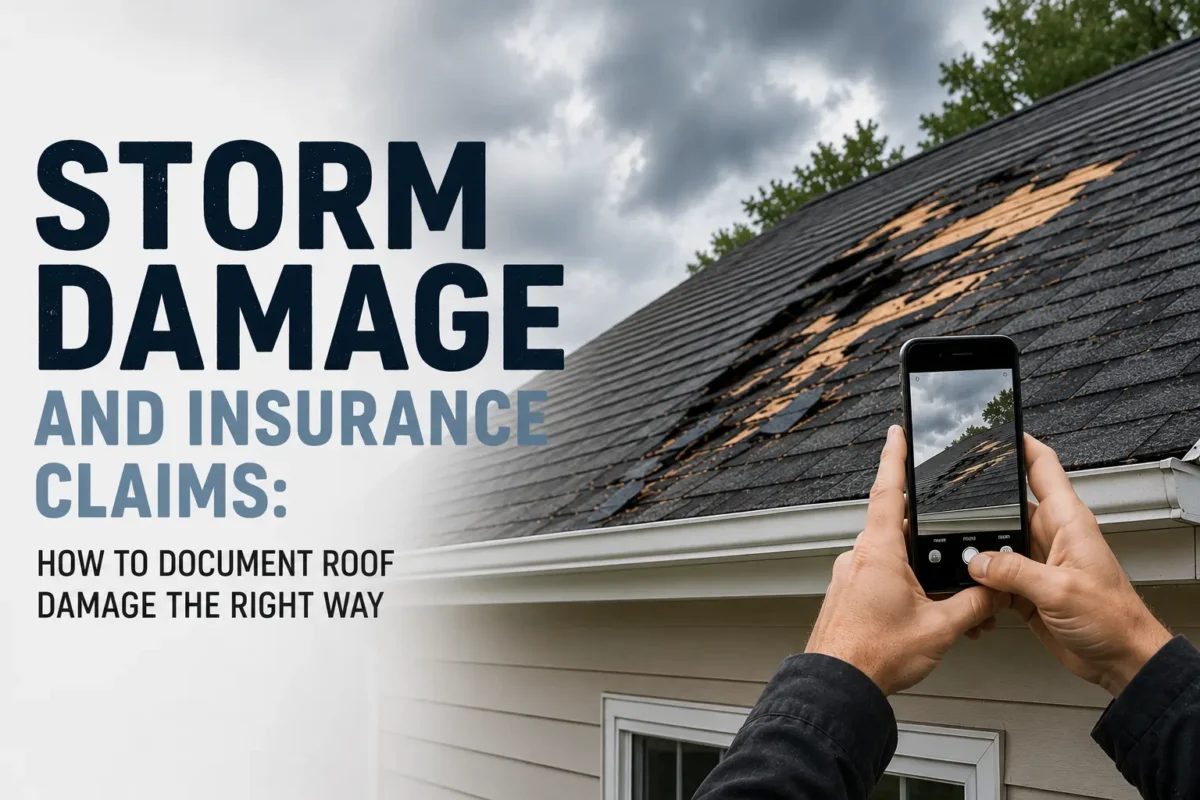
A summer storm moves through Bucks County overnight. By morning there are shingles in the yard, a ceiling stain that wasn’t there before, and a branch sitting in the gutter. You call your insurance company, and the process that follows—the adjuster visit, the documentation requirements, the scope negotiations—turns out to be nothing like you expected. The claim gets underpaid, or denied outright on a technicality. The repair you needed covered ends up largely out of pocket.
This is one of the most common and most avoidable outcomes we see for Bucks County and Montgomery County homeowners after storm events. The problem is almost never the damage itself—it’s the documentation. Insurance adjusters work from what they can see and verify. Homeowners who know how to document damage thoroughly, engage the process correctly, and work with a qualified roofing contractor during the claim are far more likely to receive fair settlements than those who hand the process entirely to their insurer and hope for the best.
Franco Roofing, Inc. has been working alongside Bucks County and Montgomery County homeowners through the insurance claim process for more than 54 years. We have seen what documentation works, what adjusters look for, and where claims fall apart. This guide covers everything you need to know to protect your claim from the moment the storm passes.
What You’ll Learn
- Why roof storm damage claims get underpaid or denied—and what you can do about it
- The real causes of claim failures for Bucks County homeowners
- How to document storm damage correctly, step by step
- How to work with your insurer and a qualified contractor to maximize your claim
- Why Bucks County homeowners trust Franco Roofing for post-storm damage assessment
- Frequently asked questions about roof insurance claims in Pennsylvania
The Problem: Why Roof Storm Damage Claims Get Underpaid or Denied
Homeowners’ insurance is supposed to protect your home from storm damage. In practice, the amount you receive depends heavily on the quality of documentation and representation you bring to the claim. Insurance adjusters are professionals whose job includes limiting claim payouts within policy terms. That is not an accusation—it is simply how the system works. A homeowner who understands this and prepares accordingly is in a fundamentally different position than one who doesn’t.
Pennsylvania’s summer storm season consistently produces roof damage events across Bucks County and Montgomery County: high-wind events that lift shingles and flashings, hail storms that damage roofing material in ways not always visible from the ground, and heavy rain events that expose pre-existing vulnerabilities in roof systems. Each type of damage has specific documentation requirements that determine how—and whether—a claim is paid.
Signs your property may have storm damage requiring a claim:
- Missing, lifted, or displaced shingles visible from ground level
- Shingle granules in gutters or on the ground (indicates hail or high-wind impact)
- Dents or damage visible on gutters, downspouts, or metal roof components
- Flashing lifted or displaced at chimney, dormers, or vents
- Interior ceiling staining that appeared or grew after a storm event
- Tree branches, debris, or foreign objects on the roof surface
- Damage to siding, skylights, or exterior structures consistent with hail or wind
Why Claims Fail: The Real Causes of Underpayment and Denial
In our 54 years working with Bucks County and Montgomery County homeowners through the insurance claim process, these are the root causes we see most consistently when claims are underpaid or denied.
1. Delayed Reporting and Evidence Loss
Most homeowner policies require prompt reporting of damage after a storm event. More importantly, evidence degrades quickly. A hail strike on an asphalt shingle produces a specific bruising pattern that becomes harder to distinguish from normal wear as weeks pass. Wind damage that displaces flashing begins to look like age-related failure after a few rain cycles. Adjusters are trained to identify storm-specific damage patterns, and those patterns are clearest in the days immediately following an event. Homeowners who wait two or three weeks to assess and report are working with compromised evidence.
2. Inadequate or Incomplete Documentation
The single most common cause of underpaid claims is documentation that doesn’t capture the full scope of damage. Homeowners take a few photos from the ground, submit them with the claim, and then discover the adjuster’s scope covers only a fraction of what actually needs repair. Insurance adjusters work from the documentation they receive. If damage to the north-facing slope wasn’t photographed, if the damaged underlayment isn’t documented by a professional, if the flashing failure at the dormer isn’t captured—those items won’t appear in the estimate. Close-up, date-stamped photography from multiple angles and positions, combined with a written contractor assessment of all affected components, is the documentation standard that produces complete claim coverage.
3. Pre-Existing Condition Disputes
Insurers routinely contest storm damage claims by attributing damage to pre-existing wear rather than the storm event. This is a legitimate adjustment in cases where wear was the actual cause—but it is also a frequently over-applied denial reason on roofs that have genuine storm damage. A roof with 15-year-old shingles that sustains hail damage has genuine storm damage, regardless of the shingles’ age. The difference between a successful claim and a denied one on this issue often comes down to whether a qualified roofing contractor has documented the storm-specific damage patterns—hail bruising, uniform directionality of wind damage, impact points on soft metals—that distinguish storm damage from normal aging.
4. Storm Chasers and Unqualified Contractors
After significant storm events in Bucks County and Montgomery County, out-of-area contractors arrive aggressively soliciting homeowners for insurance claim work. These “storm chasers” often have no established presence in the region, no track record with local insurers, and no accountability after the job is done. In our experience, storm chaser involvement frequently produces one of two bad outcomes: a contractor who inflates the claim scope in ways that create documentation conflicts with the adjuster, or one who performs inadequate repair work that fails within a year. Working with a local, established contractor who the insurer and local building departments recognize by name produces better outcomes at every stage of the process.
How to Document Storm Damage Correctly: A Step-by-Step Guide
The window for optimal documentation is the 24 to 72 hours immediately following a storm event. Here is the sequence that produces the strongest claim documentation for Bucks County and Montgomery County homeowners.
- Record the date, time, and weather event. Before doing anything else, note the specific date and approximate time of the storm and take a screenshot of the weather record for that day from a local weather service or news outlet. NOAA’s Storm Events Database and Weather.gov provide date-specific weather records that can confirm storm event details if your insurer requests verification. This establishes the causal event your claim is built on.
- Photograph exterior damage immediately. Do a full exterior walkthrough and photograph everything you can observe at ground level: shingles on the ground or in gutters, granule accumulation, visible damage to gutters and downspouts, displaced or lifted materials on the roof surface, and any damage to siding, window screens, HVAC equipment, or other exterior components. Date-stamp is important—use your smartphone camera with location services enabled, which automatically records the date and time in the image metadata.
- Document interior damage. Check all interior ceilings and attic space within 24 hours. Photograph any new staining, wet insulation, or moisture evidence in the attic. Mark ceiling stain perimeters with a pencil so you can track whether they expand before the adjuster visits. If there is active dripping or water intrusion, place containers and document the locations photographically.
- Save all physical evidence. Collect and save shingles or shingle fragments that have fallen from the roof. These are physical evidence of the damage and its extent. Hail-damaged shingles show specific bruising patterns that an adjuster or contractor can assess. Don’t discard any fallen material until your claim is settled.
- Take protective measures if needed—and document them. If there is active water intrusion, temporary protection (tarping, for example) may be necessary. Do not make permanent repairs before the adjuster’s visit—this can complicate coverage—but temporary protective measures are appropriate and generally covered by standard policies. Document any protective measures you take with photographs before and after.
- Schedule a professional contractor inspection before the adjuster visit. A qualified roofing contractor’s written assessment of damage—completed before or simultaneously with the adjuster visit—provides independent documentation of scope. This is one of the most valuable steps in the process. The contractor can access the roof surface, document damage that isn’t visible from the ground, identify all affected components, and provide a written scope that gives you a baseline against which to evaluate the adjuster’s findings.
- File the claim promptly. Contact your insurer as soon as your initial documentation is complete—ideally within 24 to 48 hours of the storm event. Provide your documentation package: date-stamped photographs, weather records, contractor assessment if available, and a written description of what you observed. Most standard homeowner policies have prompt-reporting requirements; late filing can become a basis for denial.
Working with Your Insurer and Contractor to Maximize Your Claim
Be Present at the Adjuster Inspection
When the adjuster visits, be present and have your documentation ready. Walk the adjuster through the damage you’ve documented—don’t assume they’ll find everything on their own. If you have already had a contractor assess the damage, share that written assessment with the adjuster during the visit. Ask the adjuster to explain their findings and document scope before they leave. Clarifying questions at the inspection visit are far easier to resolve than disputes after the estimate is issued.
Review the Adjuster’s Scope Against the Contractor’s Assessment
When you receive the adjuster’s written scope and estimate, compare it line by line against your contractor’s assessment. Gaps—items in the contractor’s assessment that don’t appear in the adjuster’s scope—are the basis for a supplemental claim. Common gaps include underlayment replacement, decking damage, flashing replacement, drip edge, and interior repair costs. A qualified contractor can help you identify what’s missing and prepare a documented supplement request.
Understand Actual Cash Value vs. Replacement Cost Value
Most standard homeowner policies in Pennsylvania pay roof claims on one of two bases: Actual Cash Value (ACV), which deducts depreciation based on the roof’s age, or Replacement Cost Value (RCV), which pays the full cost of replacing the damaged material with new material of like kind and quality. If your policy pays RCV, you typically receive the ACV amount initially, with the depreciation holdback released after the repair is completed and documented. Knowing which basis your policy uses—and the depreciation schedule your insurer applies—is essential to understanding whether the initial payment is the full settlement or a partial payment.
What Not to Do During the Claims Process
Several common mistakes significantly weaken storm damage claims:
- Making permanent repairs before the adjuster visit. This eliminates the adjuster’s ability to assess the original damage scope and can result in reduced or denied coverage.
- Signing a contractor’s Assignment of Benefits (AOB) form. This transfers your claim rights to the contractor. While not illegal in Pennsylvania, it removes your direct control over how the claim is managed and settled.
- Accepting the first settlement without review. Initial adjuster estimates are frequently incomplete. Review against your contractor’s assessment before accepting any settlement.
- Working with a contractor you can’t verify. Confirm Pennsylvania licensure, insurance, and local references before engaging any contractor for storm work. Ask specifically about their experience working with insurance claims in Bucks County and Montgomery County.
Why Bucks County Homeowners Trust Franco Roofing for Post-Storm Damage Assessment
Navigating an insurance claim for roof storm damage is not just a roofing problem—it requires a contractor who understands the documentation standards insurers use, communicates clearly and professionally with adjusters, and provides the kind of written assessment that stands up to scrutiny. Franco Roofing, Inc. has been that contractor for Bucks County and Montgomery County homeowners for more than 54 years.
When a homeowner in Doylestown, New Hope, Newtown, or anywhere across our service area calls us after a storm, we conduct a thorough professional inspection of the full roofing system—not just what’s visible from the ground. We provide a written assessment that documents all storm-related damage in the specific language that insurance adjusters are trained to evaluate: impact patterns, displacement type, affected components, and scope of repair or replacement required. We will walk through our findings with the homeowner and, when useful, with the adjuster directly.
We are not storm chasers. We have been in Bucks County since 1971. The local insurance adjusters who operate in our market know our name, our work, and our reputation for accurate assessments. That relationship—built over 54 years—makes a difference when scope disputes arise.
Franco Roofing is fully licensed in Pennsylvania (PA #PA018056) and New Jersey (NJ #13VH07058000), carries a $2,000,000 general liability policy and workers’ compensation, and backs all repair and installation work with our 10-year workmanship warranty. Emergency service is available 24/7 for active damage situations. 80% of our business comes from referrals—including homeowners who called us the first time because of a storm, and came back every time after that because of the experience.
Frequently Asked Questions
How soon after a storm should I file a roof damage insurance claim in Pennsylvania?
File as soon as your initial documentation is complete—ideally within 24 to 48 hours of the storm event. Most Pennsylvania homeowner policies have prompt-reporting requirements, and storm-specific damage evidence is strongest immediately after an event. Waiting more than a week increases the risk of adjusters attributing damage to wear rather than the storm.
What documentation does a homeowner insurance company need for a roof storm damage claim?
At minimum: date-stamped photographs of all exterior and interior damage, weather records confirming the storm event, and a written description of what you observed. Strongest claims also include a professional contractor’s written assessment documenting damage scope and affected components before permanent repairs are made. The more specific and complete your documentation, the less room for the adjuster to minimize scope.
My insurance adjuster said the damage is from wear and tear, not the storm. What can I do?
This is a common dispute. Storm-specific damage has identifiable patterns—hail bruising on shingles, directional displacement consistent with wind, impact marks on soft metals—that distinguish it from normal aging. A written assessment from a qualified roofing contractor documenting these storm-specific patterns is the strongest response. If the dispute persists, you have the right to request reinspection and to engage a licensed public adjuster to represent your interests in the claim.
What is the difference between Actual Cash Value and Replacement Cost Value on a roof claim?
Actual Cash Value (ACV) pays the depreciated value of the damaged material based on its age. Replacement Cost Value (RCV) pays the full cost of replacing damaged material with new material of like kind and quality, with depreciation released after repairs are completed and documented. RCV policies produce higher settlements on older roofs. Check your policy declarations page to confirm which basis your policy uses before filing.
Can I make temporary repairs before the adjuster visits?
Yes. You have a duty under most policies to prevent further damage, which may include tarping or other temporary protective measures. Document all temporary repairs with photographs before and after. Do not make permanent repairs—shingle replacement, flashing work, or any other permanent fix—before the adjuster completes their assessment. Permanent pre-adjuster repairs can result in reduced or denied coverage for the affected area.
What should I look for when choosing a roofing contractor for insurance claim work in Bucks County?
Verify Pennsylvania contractor licensure, comprehensive general liability insurance, and workers’ compensation coverage. Ask for local references from Bucks County or Montgomery County projects. Be cautious of out-of-area contractors who arrive immediately after storms soliciting business—these storm chasers frequently produce documentation conflicts and poor workmanship. A contractor with an established local presence and a track record of working with insurance adjusters in your area will navigate the process most effectively.
Does Franco Roofing help with the insurance claim process?
Yes. Franco Roofing conducts thorough post-storm assessments and provides written documentation of all storm-related damage in the format insurance adjusters use. We can be present during the adjuster’s inspection, review the adjuster’s scope against our findings, and help identify grounds for supplemental claims when the initial estimate is incomplete. We don’t act as public adjusters—that’s a licensed profession—but as the contractor, we provide the technical documentation and professional expertise that supports a complete and accurate claim.
Next Steps: Move Quickly and Document Everything
If your Bucks County or Montgomery County home has sustained roof damage in a storm, the actions you take in the first 24 to 72 hours determine the quality of your claim. Document thoroughly, report promptly, get a professional assessment before permanent repairs, and work with a contractor who knows the process.
Key takeaways:
- Document with date-stamped photographs within 24 hours—before evidence degrades
- Get a contractor’s written assessment before or during the adjuster visit, not after
- Do not make permanent repairs before the adjuster completes their assessment
- Avoid out-of-area storm chasers—work with an established local contractor with a verifiable track record
Contact Franco Roofing, Inc. for emergency assessment and claim documentation support:
- Doylestown: (215) 345-1828
- Newtown: (215) 860-1550
- Pipersville: (215) 766-0266
- Email: francoroofinginc@verizon.net
- Website: francoroofinginc.com
Emergency service is available 24/7. We respond within 24 hours for non-emergency inquiries and can typically schedule assessments within one week. Serving Bucks County, Montgomery County, and Western New Jersey since 1971.