
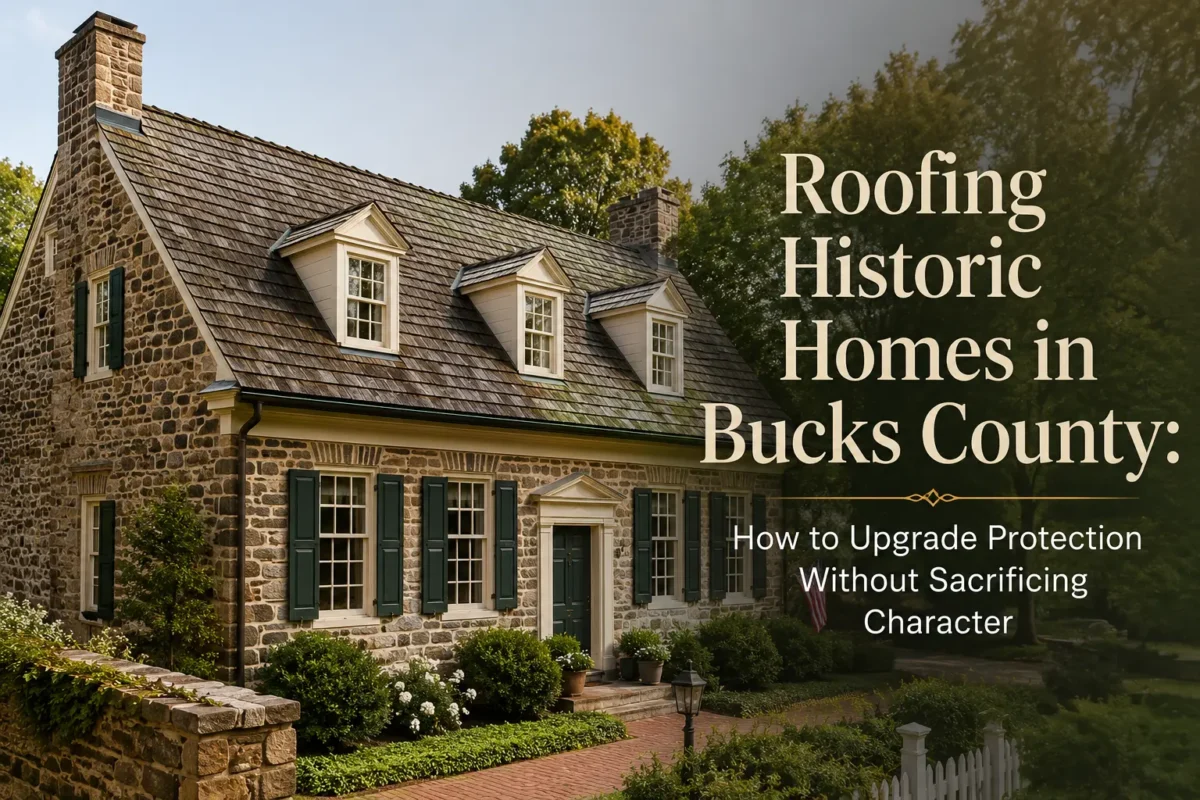
Bucks County has one of the most significant concentrations of historic residential architecture in Pennsylvania. From the 18th-century stone farmhouses of Solebury and Buckingham to the Victorian streetscapes of Doylestown and New Hope, from the Federal and Colonial Revival properties lining the streets of Newtown to the craftsman bungalows of Perkasie and Sellersville—the region’s built environment is genuinely irreplaceable. The roofs on these homes are not incidental details. They define the silhouette, character, and often the legal compliance status of the property.
When the roof on a historic Bucks County home reaches the end of its service life, the replacement decision is more complex than a standard re-roofing project. Material selection, profile matching, historic commission approval, and the technical demands of installation on structures with unusual geometries and century-old framing all require a level of expertise that most roofing contractors simply do not have. The wrong decision—a material that doesn’t suit the architecture, a commission submission that gets rejected, an installation that compromises the structure—is expensive, time-consuming, and in some cases irreversible.
Franco Roofing, Inc. has been working on historic Bucks County and Montgomery County properties since 1971. Slate and cedar shake roofing—the materials most common on the region’s historic homes—are our signature specialties. Over more than 50 years, we have navigated historic commission reviews, sourced matching materials for century-old roofing systems, and installed both traditional and high-quality modern alternatives on some of the most significant residential properties in the region. Here is what that experience tells us every historic home owner needs to understand before starting a roofing project.
What You’ll Learn
- Why roofing a historic Bucks County home is fundamentally different from a standard replacement
- The real causes of roofing failures on historic homes—and what makes them harder to fix
- How to assess your options: natural materials vs. high-quality modern alternatives
- Navigating historic commission requirements in Doylestown, New Hope, and other Bucks County communities
- Why Bucks County historic property owners choose Franco Roofing
- Frequently asked questions about historic home roofing in Pennsylvania
The Problem: Why Roofing a Historic Home Is Not a Standard Project
The roofing challenges unique to historic Bucks County homes fall into three distinct categories: structural, regulatory, and material. Understanding all three is essential before making any decisions.
Structurally, historic homes were built with framing systems, roof geometries, and load assumptions that differ substantially from modern construction. A Victorian home in Doylestown’s historic district may have a complex roof profile—multiple intersecting planes, steep pitches, dormers, turrets, and elaborate cornice details—that requires specialized installation technique and significant experience to navigate correctly. The framing beneath may be hand-hewn timber, dimensional lumber of non-standard sizing, or in some cases a combination of original and modified material from decades of previous work. Installing a new roofing system over this substrate demands both roofing expertise and an understanding of historic building construction.
Regulatory requirements add a layer of complexity that many homeowners underestimate. Properties in designated historic districts—Doylestown’s historic district, New Hope Borough, Newtown Borough, and others throughout Bucks County—are subject to review by local historic preservation commissions. These bodies have authority over material selection, color, and profile, and their approval must be obtained before permitted roofing work can proceed. The approval process has its own timeline, documentation requirements, and standards that an experienced contractor can navigate far more efficiently than a homeowner working through it for the first time.
Common challenges historic Bucks County homeowners face when replacing their roof:
- Finding a contractor with genuine experience on the specific roofing material and property type
- Sourcing replacement slate, cedar, or metal that matches the existing system in appearance and performance
- Navigating historic commission approval without delaying the project by multiple months
- Evaluating modern alternatives (synthetic slate, composite materials) against traditional options
- Managing cost on a project where “good enough” is not an acceptable outcome
- Ensuring new roofing integrates correctly with existing historic details—cornice, fascia, flashing profiles
Why Roofing Projects on Historic Homes Go Wrong
When historic home roofing projects fail—in the sense of producing an outcome that damages the property’s character, fails regulatory review, or deteriorates prematurely—these are the root causes we see most consistently.
1. Contractor Selection Without Historic Experience
The most common cause of historic home roofing failures is engaging a contractor who lacks genuine experience with the specific material and property type. Most roofing contractors are competent at standard asphalt shingle installations on contemporary construction. Far fewer have the hands-on experience needed to work correctly on a 100-year-old slate roof with original hand-cut flashings, or to properly install cedar shake on a steeply pitched Victorian with multiple valley intersections. The consequences of this mismatch are permanent: improperly installed slate fails within years rather than decades; mismatched replacement material alters a property’s historic character in ways that cannot be undone without replacing the entire roof system.
2. Material Substitution That Violates Historic Character
Not all modern roofing alternatives are appropriate for historic properties. Standard 3-tab or even architectural asphalt shingles on a Victorian or Federal-style home in Doylestown’s historic district create a visual anachronism that reduces the property’s historic integrity and may violate commission standards. The challenge is distinguishing between modern alternatives that authentically replicate historic appearances—high-quality synthetic slate composites like EcoStar or Inspire, which commissioners in some jurisdictions approve as equivalent to natural slate—and lower-quality substitutions that approximate the look without achieving it. This distinction requires material knowledge that comes from working extensively with both traditional and modern options.
3. Bypassing or Mismanaging the Commission Approval Process
Historic commission approval in Bucks County communities is not optional for designated properties—it is a legal requirement that precedes permit issuance. Homeowners who attempt to proceed without approval, or who submit incomplete applications, face stop-work orders, required removal of installed material, and significant legal and financial exposure. The commission review process has specific documentation requirements: material samples, manufacturer specifications, photographic context of the existing roof and adjacent properties, and often a written justification for the proposed material choice. An experienced contractor who has submitted to these commissions previously understands what the application needs to contain and how to frame the submission for approval.
4. Inadequate Structural Assessment Before Installation
Historic structures frequently have decking, framing, or structural elements that have deteriorated in ways not apparent without close inspection. Installing new roofing over compromised decking—or failing to identify load-bearing concerns before switching from a lightweight material to a heavier one, or vice versa—creates structural problems that manifest after installation and are expensive to correct. Natural slate is among the heaviest roofing materials available. A historic home whose framing was engineered for a slate load can typically support a new slate installation; one whose framing was modified over the decades to support lighter material may not. This assessment requires both roofing knowledge and an understanding of historic structural systems.
Evaluating Your Options: Traditional Materials vs. Modern Alternatives
The material choice on a historic Bucks County roofing project is the most consequential decision you will make. Here is an honest assessment of the main options, their performance characteristics, and their suitability for different property types and regulatory contexts.
Natural Slate: The Original Standard
For historic properties where the original roof was slate—common on Victorian, Federal, Colonial Revival, and Italianate homes throughout Doylestown, New Hope, and Newtown—natural slate replacement-in-kind is the gold standard. Hard-vein Vermont and Virginia slate installed correctly will last 75 to 100-plus years, match the original material’s appearance with precision, and satisfy historic commission requirements in virtually every jurisdiction. The investment is significant: natural slate replacement on a mid-size historic home typically runs $25,000 to $60,000 or more depending on roof complexity. For properties where the slate is the defining architectural feature and long-term preservation is the goal, this investment is justified.
Franco Roofing sources natural slate from domestic quarries—Vermont and Virginia—as well as trusted international suppliers for specific applications. We match replacement slate to the existing field in thickness, color range, and surface texture. This is not a detail we approximate; on a historic property, it is a requirement.
Synthetic Slate Composites: High-Quality Alternatives That Work
High-quality synthetic slate composites—EcoStar Majestic Slate, Inspire Roofing’s slate profile—are manufactured from recycled rubber and plastic to replicate the dimensional appearance and shadow lines of natural slate. At a fraction of the weight of natural slate, they do not require structural reinforcement and can be installed on frames that would not support a natural slate load. Their expected lifespan is 40 to 50 years with minimal maintenance. They carry Class A fire ratings and Class 4 impact resistance.
For Bucks County historic property owners who need slate appearance without the full cost or structural requirements of natural slate, these products represent a genuine solution—not a compromise. They have been approved by historic commissions in Pennsylvania and New Jersey when submitted correctly with full manufacturer documentation. Franco Roofing is a certified EcoStar and Inspire installer and has successfully navigated commission approval for synthetic slate on Doylestown and New Hope properties. The critical factor is product selection and installation quality; not all synthetic slate products are equivalent, and installation by a certified specialist is essential to achieving the warranted performance.
Cedar Shake and Cedar Shingle: For Craftsman, Colonial, and Mid-Century Properties
Cedar shake and cedar shingle roofing is appropriate for historic properties where the original material was cedar—common on Bucks County craftsman bungalows, colonial revivals, and mid-century properties in communities like Warminister, Chalfont, and parts of Doylestown. Cedar’s natural appearance, dimensional profile, and aging character make it the correct material choice for these property types. Franco Roofing installs both hand-split cedar shake and sawn cedar shingles, sourced from quality suppliers and available in the grades appropriate for 30-to-40-year service life in Pennsylvania’s climate. High-quality composite cedar alternatives are also available for properties where fire codes or commission requirements preclude natural wood.
Copper and Standing Seam Metal: For Historic Commercial and Distinctive Residential Properties
Copper roofing and standing seam metal systems have a long history on high-end American residential and institutional architecture. On Bucks County properties where the original roof included copper elements—valleys, bay roofs, dormer caps—maintaining or restoring those elements in copper preserves the property’s historic material palette and its associated longevity. Copper, installed correctly, lasts over 100 years. Standing seam metal—in both traditional and Kynar-coated profiles—is also appropriate for certain historic agricultural conversions and 20th-century modern properties where the aesthetic is compatible. Franco Roofing installs both copper and standing seam metal systems and carries relationships with suppliers for specialty copper work on historic restoration projects.
Navigating Historic Commission Requirements in Bucks County
Historic preservation commissions in Bucks County and surrounding communities review proposed exterior alterations—including roofing replacements—for designated properties and properties within historic districts. The specific requirements and approval criteria vary by municipality, but the general framework is consistent across Doylestown Borough, New Hope Borough, Newtown Borough, and the county’s other historic districts.
- Determine whether your property requires review. Not every historic property in Bucks County is subject to commission review. Properties within locally designated historic districts are subject to local commission oversight. Properties listed on the National Register of Historic Places are subject to review only if federal or state funding or permits are involved. Your municipality’s planning department can confirm the review requirements for your specific property.
- Engage your contractor before the commission submission. The commission submission should include your contractor’s material specifications, product literature, and in many cases a written statement addressing why the proposed material is appropriate for the property. A contractor with prior commission experience in your municipality understands what the submission needs to contain and how to frame the technical information for a favorable review.
- Submit early in the project timeline. Historic commissions in Bucks County typically meet monthly. A submission that misses one meeting cycle adds four to six weeks to the project timeline. Starting the submission process as early as possible—ideally at the same time material selection is being finalized—keeps the project on schedule.
- Be prepared to provide material samples. Most commissions require physical material samples—typically roof tile or shake samples—in addition to written specifications. For synthetic slate products, manufacturer-supplied comparison samples showing the product alongside natural slate are useful supporting documentation.
- Understand the approval’s scope. Commission approval covers the specific material, color, and installation approach described in the application. Any deviation from the approved scope—a different color run, a modified material—requires a new or amended submission. Your contractor should document the approved specification clearly and adhere to it precisely during installation.
Why Bucks County Historic Property Owners Choose Franco Roofing
Working on historic Bucks County homes is not a sideline for Franco Roofing—it is a core part of what we have done since Franco Procaccino founded the company in 1971. The region’s historic architecture was our training ground and has been our consistent focus for more than 50 years. Michael Procaccino, with 25-plus years of direct experience on slate, cedar, and metal roofing systems, has managed projects on some of the most architecturally significant residential properties in Doylestown, New Hope, Solebury, Buckingham, and throughout the Delaware Valley.
Our material knowledge is deep and specific. We know the difference between Vermont hard-vein and Pennsylvania soft-vein slate by look and feel. We know which synthetic slate products perform to their warranty specifications and which don’t. We know how to source cedar that matches a 1930s installation in texture and grade. We know how lead flashings integrate with historic slate coursing and why modern flashing approaches fail on historic details. This knowledge comes from decades of hands-on work—not from a product catalog.
We have submitted to historic commissions in Doylestown, New Hope, and other Bucks County municipalities and understand their documentation requirements, approval criteria, and the kinds of materials they have historically approved or rejected. That experience shortens the approval timeline and reduces the risk of submission failure.
Franco Roofing is fully licensed in Pennsylvania (PA #PA018056) and New Jersey (NJ #13VH07058000), carries a $2,000,000 general liability policy and workers’ compensation, and backs all installation work with our 10-year workmanship warranty—on top of manufacturer warranties for all premium products installed. 80% of our business comes from referrals. On historic properties, where the stakes of getting the work right are highest, that track record is the most relevant qualification.
Frequently Asked Questions
Do I need historic commission approval to replace the roof on my Doylestown or New Hope home?
It depends on whether your property is within a locally designated historic district or is subject to local historic preservation ordinance. Properties in Doylestown Borough’s historic district, New Hope Borough, Newtown Borough, and other designated Bucks County communities generally require historic commission approval for exterior alterations including roofing. Your municipality’s planning department can confirm whether your property is subject to review and what the submission requirements are.
Will a historic commission approve synthetic slate for my historic Bucks County home?
High-quality synthetic slate composites—EcoStar Majestic Slate, Inspire Roofing—have been approved by Pennsylvania historic commissions in multiple jurisdictions when submitted with complete manufacturer documentation, material samples, and a clear technical rationale. The key factors are product quality, dimensional accuracy relative to natural slate, and the quality of the commission submission. Franco Roofing has navigated this process successfully in Bucks County and can advise on the likelihood of approval for specific properties and municipalities.
Can I replace natural slate with asphalt shingles on a historic home?
In most cases, asphalt shingles are not approvable by historic commissions in designated districts as a replacement for original slate or cedar on historic properties—they do not replicate the dimensional profile, shadow lines, or material character of the original roofing. Beyond commission requirements, asphalt shingles on a Victorian or Federal-style home significantly alter its architectural character in ways that reduce historic integrity and often property value. For properties where cost is the primary driver, high-quality synthetic slate or composite options provide a better outcome at a price point between asphalt and natural slate.
How much does it cost to replace the roof on a historic home in Bucks County?
Cost depends on material choice, roof complexity, size, and the condition of the underlying decking and framing. Natural slate on a mid-size historic home typically runs $25,000 to $60,000 or more. High-quality synthetic slate composites run $15,000 to $35,000 for similar scope. Cedar shake falls in the $18,000 to $40,000 range depending on material grade and complexity. Standing seam metal and copper are priced based on specific project scope. Franco Roofing provides free, detailed written estimates for all historic roofing projects throughout Bucks County and Montgomery County.
How do I know if my historic slate roof can be repaired rather than replaced?
The repair-versus-replace decision on a historic slate roof depends on the percentage of failing tiles across the field, the condition of the underlayment, and the state of the fastening system. When failing slates are below 20 to 25 percent of the total field and the underlayment remains functional as a secondary water barrier, targeted repair is typically the right choice—preserving the original material and extending the roof’s life cost-effectively. Above that threshold, or when underlayment has failed, re-roofing is more economical. A professional assessment by a slate specialist is the only reliable basis for this decision.
Does Franco Roofing work on historic properties in Montgomery County and Western New Jersey?
Yes. Franco Roofing provides historic home roofing services throughout Bucks County and Montgomery County in Pennsylvania—including Ambler, Fort Washington, Blue Bell, Lansdale, and Glenside—and in Western New Jersey including Princeton, Lambertville, Hopewell, and Pennington. Historic properties in these communities present the same material and regulatory challenges as Bucks County properties, and we bring the same depth of experience to each. Call (215) 345-1828 to confirm service to your address.
Will a new roof affect my historic property’s value or tax status?
A properly executed historic roof replacement—using materials that match the original in character and that satisfy commission requirements—preserves and often strengthens historic property value. A roof replacement that violates historic character or commission standards can negatively affect value and historic certification status. Some Pennsylvania municipalities and the National Park Service’s Tax Incentive Programs offer tax benefits for certified historic preservation work; a properly documented historic-compliant roof replacement may qualify. Consult with your tax advisor and the Pennsylvania State Historic Preservation Office for specifics applicable to your property.
Next Steps: Start With the Right Specialist
A historic Bucks County home deserves a roofing contractor who understands its material, its architecture, and its regulatory context. The consequences of choosing wrong—in terms of commission approval, structural integrity, material performance, and the property’s long-term character—are too significant to treat this as a standard re-roofing decision. Start with a contractor who has done this work, on properties like yours, in communities like yours, for decades.
Key takeaways:
- Material selection on a historic property is a regulatory and preservation decision, not just a cost decision
- High-quality synthetic slate composites can satisfy historic commission requirements when submitted correctly
- Commission approval must be obtained before permits are issued—start this process early
- Structural assessment of decking and framing before material installation is non-negotiable on historic structures
Contact Franco Roofing, Inc. for a free historic roofing consultation and estimate:
- Doylestown: (215) 345-1828
- Newtown: (215) 860-1550
- Pipersville: (215) 766-0266
- Email: francoroofinginc@verizon.net
- Website: francoroofinginc.com
We respond within 24 hours and can typically schedule consultations within one week. Serving Bucks County, Montgomery County, and Western New Jersey since 1971.