
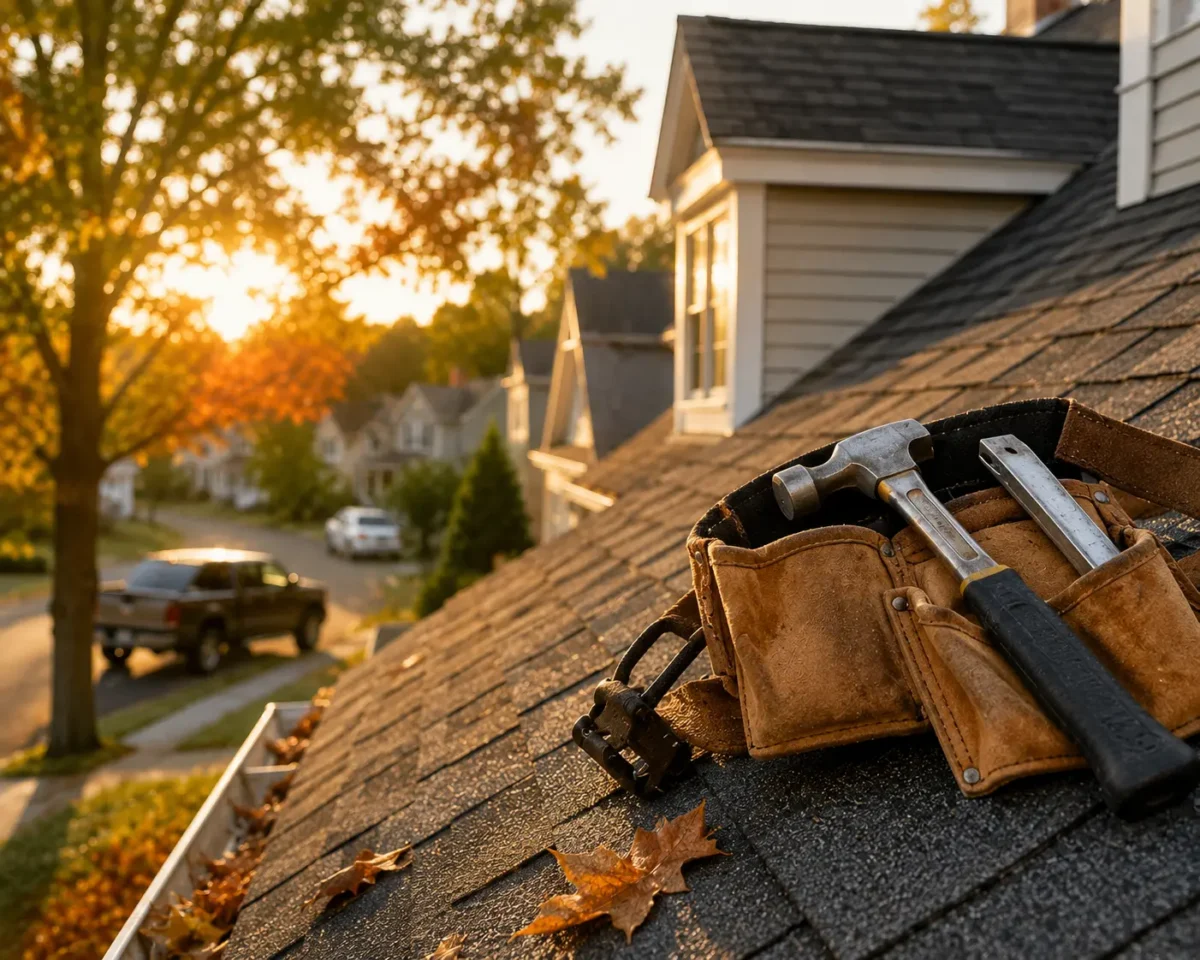
Every fall, Bucks County and Montgomery County homeowners discover the same frustrating reality: the roofing contractor they want is booked four to six weeks out. The project they’d been meaning to address since spring is now racing against the first hard frosts of November. Material lead times that were comfortable in August have become tight. And the October weather window—when Pennsylvania delivers its best conditions for roofing installation—is closing faster than the schedule allows.
None of this is inevitable. It is the predictable result of a scheduling decision made too late. Fall is genuinely the best season for roofing work in Pennsylvania—the temperatures, the dry weather patterns, and the asphalt curing conditions are all favorable. Every quality roofing contractor in our market knows this. So does every homeowner who waited too long and learned from it. The ones who secure fall installation slots in August work with the contractor they actually want, on the timeline that works for them, without the pressure of narrowing weather windows.
Franco Roofing, Inc. has been managing roofing schedules and project timelines across Bucks County and Montgomery County since 1971. We see this pattern play out every year: August callers get October installation; October callers get November at best, or a spring slot that means wintering over a compromised roof. Here is the full picture of why fall is the right season for roof work in Pennsylvania—and why August is the right time to book it.
What You’ll Learn
- Why fall is technically the best season for roof installation and replacement in Pennsylvania
- The real reasons fall roofing schedules fill up—and what late bookers lose
- How to assess whether your roof needs fall work
- What the planning and scheduling process looks like when started in August
- Why Bucks County homeowners choose Franco Roofing for fall projects
- Frequently asked questions about fall roofing in Pennsylvania
Why Fall Is the Best—and Most Competitive—Season for Roof Work in Pennsylvania
Pennsylvania’s roofing installation calendar has a clear best window, and it runs from September through early November. The reasons are both technical and practical, and understanding them helps homeowners make the timing decision with full information.
On the technical side, asphalt shingles require temperatures above 40 degrees Fahrenheit during installation for the self-sealing adhesive strip to activate correctly—the bond that holds courses together and provides wind resistance. Pennsylvania’s fall consistently delivers daytime temperatures in the 55 to 75 degree range through October, which is ideal. The material cures properly, seals fully, and achieves its rated wind resistance before winter arrives. Fall also tends to deliver more stable precipitation patterns than spring—fewer multi-day rain events, more predictable windows for installation work.
For premium materials—natural slate, cedar shake, standing seam metal—fall installation is even more favorable. The moderate temperatures and low humidity of October are ideal for the precision work these materials require. And with winter approaching, completing a premium installation before the first freeze ensures the new system is fully settled and performing before Pennsylvania’s most demanding weather season begins.
Signs your roof may need fall attention before winter:
- Asphalt shingles showing widespread granule loss, curling, or cracking across 15 percent or more of the surface
- Known flashing vulnerabilities at chimney, dormers, or skylights that produced any interior moisture this past year
- A roof aged 18 or more years on asphalt that hasn’t had a professional inspection in two or more years
- Ice dams last winter—a reliable indicator of ventilation and/or shingle system issues that should be resolved before next winter
- Any interior attic moisture or ceiling staining observed during the past 12 months
- A contractor recommendation for replacement during a recent inspection or insurance-related assessment
- A home sale or major renovation planned for spring 2027 that requires the roof to be in documented good condition
Why Fall Schedules Fill Up—and What Late Bookers Actually Lose
The dynamics that compress fall roofing availability in Bucks County and Montgomery County are consistent year over year. Understanding them makes clear why August action produces October installation while October inquiry produces a very different outcome.
1. Post-Storm Demand Hits in September and October
Pennsylvania’s late-summer and early-fall storm season—including tropical weather events, September thunderstorms, and the first significant nor’easters of October—produces a concentrated burst of storm-damage work that fills contractor schedules rapidly. Homeowners who sustain damage and need immediate response, homeowners whose damage inspections reveal that deferred maintenance has finally produced a failure, and homeowners who have been watching a marginal roof all summer and make the decision after the first September storm all contact roofing contractors in the same compressed window. Quality contractors with established reputations—the ones Bucks County and Montgomery County homeowners actually want—fill their fall availability first. Late-season callers work with whoever remains available.
2. Contractor Capacity Is Fixed
A roofing contractor’s installation capacity in any given month is determined by crew size—and quality contractors don’t scale crew size arbitrarily to meet seasonal demand. Franco Roofing’s team of 10 specialized installers can complete a defined number of projects per month. When those slots are filled—with projects booked by homeowners who planned ahead—additional callers go to a waitlist or to the next available window. The most in-demand installation windows (October, early November) fill earliest. By mid-September, the October calendar of quality Bucks County contractors is typically committed.
3. Material Lead Times Add to the Timeline
Premium roofing materials—natural slate, EcoStar synthetic slate, cedar shake, standing seam metal panels—have procurement lead times that extend further as fall demand peaks. A homeowner who selects natural Vermont slate in August has it ordered, delivered, and on site for an October installation. A homeowner who makes the same selection in early October may find the lead time pushes the project into November, when Pennsylvania’s weather becomes a genuine installation risk. Booking in August means material selection happens without time pressure—and without the risk of a preferred product being backordered into winter.
4. Wintering Over a Compromised Roof Is Expensive
The concrete cost of booking too late is often wintering over a roof that should have been replaced or repaired before November. A roof with known vulnerabilities—lifted flashing, adhesion-failed shingles, deteriorated underlayment—that goes into a Pennsylvania winter is a roof accumulating additional damage through freeze-thaw cycles, ice dam formation, and sustained cold-weather stress. The repair scope in April is almost always larger and more expensive than it would have been in October. In cases where interior moisture damage occurs over the winter, the cost includes ceiling, insulation, and structural repair that a timely fall project would have prevented entirely.
How to Know Whether Your Roof Needs Fall Work
The most reliable answer comes from a professional inspection, but homeowners can make a reasonable preliminary assessment before engaging a contractor. Here is how to think through it.
- Check the roof’s age against material lifespan. Asphalt shingles have a typical lifespan of 20 to 25 years in Pennsylvania’s climate. If your roof is 18 or older, it is in the window where condition assessment before winter is genuinely important. Cedar shake roofs 25 years or older without recent professional service warrant inspection. Slate roofs benefit from professional assessment every one to two years regardless of age.
- Review the past year for any warning signs. Did you have any ceiling staining this past year—even faint discoloration? Ice dams last winter? Musty smell in the attic after rain? Granule accumulation in the gutters after storms? Any of these signals a roofing system that should be professionally evaluated before winter.
- Do a ground-level binocular inspection. Look for shingles that are curling at the edges, cracking across the face, or showing the irregular surface of granule loss. Look at all roof transitions—chimney, dormers, skylights—for flashing that appears lifted or separated. Any visible issue from the ground is an issue worth having assessed professionally before fall scheduling closes.
- Consider your plans for the property. If you are planning to sell in 2027, refinance, or undertake a major interior renovation that depends on a weather-tight envelope, a fall roof project that resolves known issues is the foundation that protects that investment. A roof flagged in a buyer’s inspection in spring is a worse negotiating position than one that was proactively addressed and documented the previous fall.
- When in doubt, schedule a free professional assessment in August. Franco Roofing’s free pre-fall inspection gives you a professional assessment of the roof’s current condition, a clear recommendation on whether fall work is warranted and what scope is appropriate, and first access to fall scheduling before the calendar fills. The inspection costs nothing and takes less than an hour.
What the August-to-October Process Looks Like
When a Bucks County or Montgomery County homeowner contacts Franco Roofing in August for fall work, here is the sequence that produces an October installation without the pressure that defines late-season bookings.
August: Free Inspection and Consultation
Michael Procaccino or a Franco Roofing specialist visits the property for a thorough assessment of the full roofing system. We evaluate shingle condition, flashing integrity, ventilation adequacy, decking condition where assessable, and any specific concerns the homeowner has identified. We provide an honest recommendation: replace, repair, or monitor. If work is warranted, we discuss material options with enough time for the homeowner to make a considered choice—not a pressured one.
Late August to Early September: Proposal, Material Selection, Scheduling
The homeowner receives a detailed written estimate covering all costs with full line-item transparency—no vague allowances that expand at billing time. Material is selected, confirmed with the supplier, and ordered. For premium materials with meaningful lead times—slate, synthetic slate, cedar, metal—ordering in late August ensures delivery well before the target installation window. The installation slot is confirmed on the fall calendar. Permit applications are submitted to the relevant municipality, running in parallel with material procurement rather than sequentially.
September to October: Installation
Franco Roofing’s team of 10 specialized installers—employees, not subcontractors—executes the installation in Pennsylvania’s ideal fall conditions. Most asphalt shingle replacements on residential homes are completed in one to three days. Premium material projects run longer based on scope and material type. We manage the project timeline, maintain daily communication, and leave the property clean at the end of each workday and fully cleaned at completion.
October: Final Walk-Through and Warranty Documentation
Every project closes with a final inspection, walk-through with the homeowner, and full warranty documentation—Franco Roofing’s 10-year workmanship warranty plus applicable manufacturer material warranties. The new roof is installed, sealed, and performing before Pennsylvania’s first hard freezes arrive. The homeowner goes into winter with a documented, warranted roofing system rather than a compromised one waiting for spring.
Why Bucks County Homeowners Choose Franco Roofing for Fall Projects
Franco Roofing, Inc. has been completing fall roof projects across Bucks County and Montgomery County for more than 54 years. We understand Pennsylvania’s installation season—the ideal temperature windows, the weather pattern risks, the permit timelines for each municipality in our service area, and the material lead times that require early ordering to hit fall installation slots. That institutional knowledge directly benefits homeowners who engage us in August rather than October.
Our signature specialties—slate, cedar shake, and standing seam metal—are the materials most commonly chosen by Bucks County and Montgomery County homeowners making long-term roof investments on higher-value properties. These materials reward the planning lead time that August booking provides: sufficient time for material sourcing, correct ordering, and installation in conditions that allow the specialized work they require to be done right.
Second-generation family business, founded by Franco Procaccino in 1971 and continued by Michael Procaccino. Team of 10 specialized installers—employees, not subcontractors. Licensed in Pennsylvania (PA #PA018056) and New Jersey (NJ #13VH07058000). $2,000,000 general liability policy and workers’ compensation. 10-year workmanship warranty on all installations. 80% referral-based business built across 54 years in the same communities.
The homeowners who call us in August for fall work are the ones who go into winter with a warranted, professionally installed roofing system. The ones who call in October are the ones who discover what “booked out” means. We would rather be in the first conversation.
Frequently Asked Questions
Why is fall the best time for roof installation in Pennsylvania?
Pennsylvania’s fall delivers the conditions that produce the best roofing installations: consistent temperatures between 55 and 75 degrees Fahrenheit that allow asphalt shingle adhesive to cure correctly, dry weather patterns with fewer multi-day rain events than spring, and stable conditions for the precision work required for premium materials. Fall installation also ensures a new roof is fully settled and sealed before Pennsylvania’s most demanding weather season—winter—arrives.
How early is too early to book fall roofing work?
It is not possible to book too early for fall work. August inquiries consistently result in the best fall scheduling outcomes: first access to October installation windows, adequate lead time for premium material procurement, and full time for permit applications to clear before installation. July inquiries are equally welcome. The question is never whether you called too early—it is whether you called before the schedule filled.
Can roofing work be done in November or December in Pennsylvania?
Asphalt shingle installation requires sustained temperatures above 40 degrees Fahrenheit for the adhesive to activate correctly. Pennsylvania’s late November and December conditions frequently fall below this threshold, limiting standard shingle installation. Emergency repairs can be executed in cold weather using cold-weather installation techniques, but planned replacement projects are best completed by early November. Premium materials—slate, metal, cedar—have somewhat more flexibility but also benefit from fall’s moderate installation conditions.
What if I’m not sure my roof needs replacement? Is a fall inspection still worth it?
Yes, unambiguously. A pre-fall inspection from Franco Roofing is free and provides a professional assessment of the roof’s current condition—whether that leads to a replacement recommendation, a targeted repair, or a clean bill of health that lets you go into winter with confidence. Discovering in March that a November inspection would have caught something is a far worse outcome than a free August assessment that confirms the roof is fine.
How long does a fall roof replacement take from first call to completion?
For standard asphalt shingle projects on typical residential homes, the process from first call to completed installation typically runs three to five weeks: one week for inspection and proposal, one to two weeks for material procurement and permit processing, and one to three days for installation. Premium material projects—slate, cedar, metal—run four to six weeks from first call to completion due to longer material lead times and installation duration. This timeline reinforces why August inquiry produces October installation while October inquiry often produces a November slot at the earliest.
Does Franco Roofing charge more for fall work than other seasons?
No. Franco Roofing’s pricing reflects the scope and materials of each project, not the season. Our low-overhead business model—built on referrals rather than advertising spend—keeps pricing competitive year-round. The benefit of booking in August is scheduling access, not a seasonal discount. Homeowners who call late in the season and find we are fully booked are not paying more elsewhere—they are working with whoever has availability, which is a different problem.
What areas does Franco Roofing serve for fall roofing projects?
Franco Roofing serves all of Bucks County and Montgomery County in Pennsylvania, plus Western New Jersey including Hunterdon and Mercer Counties. Bucks County communities include Doylestown, New Hope, Newtown, Perkasie, Warminster, Yardley, Quakertown, Buckingham, Solebury, and all surrounding areas. Montgomery County communities include Horsham, Lansdale, Blue Bell, Fort Washington, Ambler, Willow Grove, Hatboro, and Jenkintown. Call (215) 345-1828 to confirm service to your address and schedule a free fall inspection.
Next Steps: The Best Time to Call Is Right Now
If your roof has given you any reason for concern this year—a ceiling stain, ice dams last winter, an inspection recommendation you haven’t acted on, shingles that are showing their age—August is the moment to act. A free Franco Roofing inspection this month puts you in line for an October installation in Pennsylvania’s best roofing conditions, with the contractor and material you actually want, before winter has a chance to turn a manageable issue into a crisis.
Key takeaways:
- Fall is Pennsylvania’s best roofing season—and the most competitive for contractor availability
- Quality contractors in Bucks County and Montgomery County fill October slots by mid-September
- Premium material lead times require August ordering for October installation
- Wintering over a compromised roof is consistently more expensive than addressing it in fall
Contact Franco Roofing, Inc. for a free fall inspection and estimate:
- Doylestown: (215) 345-1828
- Newtown: (215) 860-1550
- Pipersville: (215) 766-0266
- Email: francoroofinginc@verizon.net
- Website: francoroofinginc.com
We respond within 24 hours and can typically schedule inspections within one week. Serving Bucks County, Montgomery County, and Western New Jersey since 1971.