
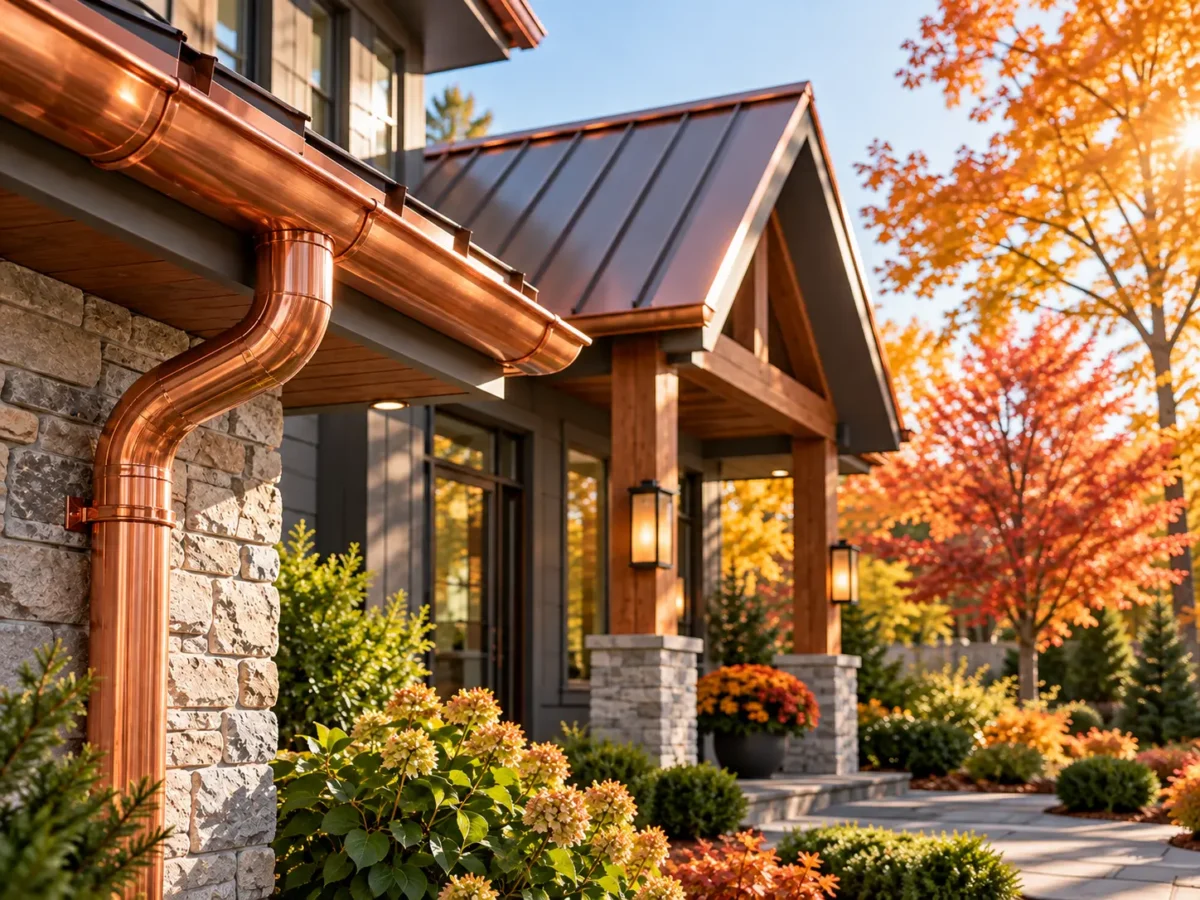
Drive through Doylestown, New Hope, or the older neighborhoods of Newtown and you’ll see copper on buildings that have been standing for over a century. Gutters darkened to a deep brown. Bay roof caps gone green with patina. Valley flashing that blends into the stonework as if it grew there. These aren’t decorative choices from a catalog. They’re the result of a material that was selected because it works—and still does, a hundred years later.
Copper gutters, copper flashing, and other metal accents on a roofing system consistently raise the question homeowners ask about most premium building materials: is it actually worth what it costs? The short answer for the right property is yes—by a significant margin when you run the numbers over the material’s expected lifespan. The longer answer depends on the property, the existing roofing system, and what problem the homeowner is actually trying to solve.
Franco Roofing, Inc. has been installing copper gutters, copper flashing, and metal roof accents on residential and commercial properties throughout Bucks County, Montgomery County, and Western New Jersey since 1971. We work with copper regularly on historic homes in Doylestown and New Hope, on high-end new construction in Newtown and Yardley, and on premium roofing system upgrades where the homeowner wants a component that will outlast everything around it. Here is the honest assessment of when copper and premium metal accents make sense—and when a less expensive option is the smarter choice.
What You’ll Learn
- What copper gutters and metal accents actually are—and how they differ from standard alternatives
- Why standard gutters and aluminum flashing fail on certain Bucks County properties
- The real case for copper: lifespan, cost-per-year, and what the material does over time
- Which properties and roofing systems benefit most from copper upgrades
- Honest situations where copper is not the right call
- Why Bucks County homeowners choose Franco Roofing for copper and metal accent work
- Frequently asked questions about copper gutters and metal accents in Pennsylvania
What Are Copper Gutters and Metal Accents?
Copper gutters are sectional or seamless rain gutter systems fabricated from 16- or 20-ounce copper sheet, installed with copper hangers and joined with soldered seams rather than the sealant-dependent joints used in aluminum systems. They are the oldest and most durable residential gutter material in continuous use—the same installation approach has been standard on quality American residential construction for well over 150 years.
Metal accents in a roofing context refers to copper or lead-coated copper used for flashing at roof transitions—chimney step and counter flashing, valley liners, skylight frames, bay roof caps, and dormer caps. On high-end historic properties throughout Bucks County, lead and copper flashing are the original materials, chosen for their ability to conform to irregular surfaces, move with the building through thermal cycling, and resist corrosion indefinitely when properly installed.
The most common copper and metal accent applications on Bucks County and Montgomery County properties:
- Half-round copper gutters on Victorian, colonial, and Federal-style historic homes
- K-style copper gutters on craftsman and mid-century properties
- Copper chimney flashing (step, counter, and cap flashing) on slate and cedar roofing systems
- Copper valley liners on complex roof planes with slate, cedar, or metal roofing
- Copper bay roof caps and turret caps on Victorian properties in Doylestown and New Hope historic districts
- Copper dormer caps on historic and high-end new construction
- Lead-coated copper step flashing integrated into slate roofing courses
Why Standard Gutters and Aluminum Flashing Fall Short on Certain Properties
Standard vinyl and aluminum gutters, and aluminum flashing, are the dominant materials in the residential roofing market because they are inexpensive and adequate for most applications. On the majority of Bucks County homes—newer construction, average property values, standard asphalt shingle roofing—they are the correct choice. The problem shows up when these materials are applied to situations they are not optimized for.
1. Standard Gutters on Premium Roofing Systems
A natural slate roof properly installed will last 75 to 100-plus years. A cedar shake roof well-maintained will last 30 to 40 years. Standing seam metal roofing has a similar multi-decade lifespan. Installing a standard aluminum gutter system—with a realistic lifespan of 20 to 25 years before replacement—beneath these materials creates a maintenance mismatch. The homeowner will replace the gutters two to four times during the life of the roof, each replacement requiring scaffolding or ladder work at the roofline, potential disruption to the drip edge and first course of roofing material, and the ongoing exposure of a lower-quality component in a system otherwise built to last. Copper gutters, properly installed and maintained, will outlast the roofing material above them.
2. Aluminum Flashing on Historic Masonry and Slate
Aluminum flashing, while adequate on standard asphalt shingle systems, presents specific problems when used as replacement flashing on historic slate roofs integrated with masonry chimneys and dormer walls. Aluminum is chemically reactive with the alkaline mortar used in historic masonry—direct contact between aluminum and mortar initiates a galvanic corrosion process that degrades the aluminum over a compressed timeframe. It also does not conform to irregular stone surfaces as readily as lead or copper, producing gaps that require sealant to fill. Those sealants degrade in Pennsylvania’s freeze-thaw cycles within five to ten years, returning the system to a leaking state. On historic properties, copper and lead flashing are not a premium indulgence—they are the technically correct choice.
3. Standard Gutters on High-Value Properties in Historic Districts
In Doylestown Borough’s historic district, New Hope Borough, and other designated Bucks County communities, historic commissions have aesthetic and material standards for exterior components that can include gutters and metal accents visible from the street. Beyond commission requirements, the resale and appraisal dynamics of high-value historic properties in Bucks County’s market mean that every exterior component contributes to the property’s presentation. A $1.2 million Doylestown Victorian with a natural slate roof and vinyl gutters presents a visible material inconsistency that a copper gutter system would eliminate. On properties at this price point, the cost differential between aluminum and copper gutters is a small fraction of the property’s value.
The Real Case for Copper: Lifespan, Cost-Per-Year, and What the Material Does Over Time
The most useful framework for evaluating copper against standard alternatives is cost-per-year rather than upfront cost. The comparison consistently favors copper on properties where the material is appropriate.
Lifespan Comparison
- Vinyl gutters: 10 to 20 years in Pennsylvania’s climate. Become brittle under freeze-thaw cycling, discolor with UV exposure, and crack at joints.
- Aluminum gutters: 20 to 30 years with maintenance. Dent, oxidize, and lose sealant integrity at joints over time.
- Galvanized steel gutters: 20 to 30 years. Rust-prone at joints and cut ends; requires regular painting.
- Copper gutters: 50 to 100-plus years with basic maintenance. Soldered seams eliminate the sealant-failure point that ends the life of other gutter systems. No painting required.
Cost-Per-Year Example
On a typical Bucks County historic home with 150 linear feet of gutters:
- Aluminum seamless gutters: approximately $1,500 to $2,500 installed. Replace every 20 to 25 years. Over 75 years: three to four installations totaling $4,500 to $10,000, plus ongoing maintenance costs.
- Copper half-round gutters: approximately $8,000 to $15,000 installed depending on profile and complexity. One installation for 75-plus years. Maintenance cost: periodic cleaning and inspection.
The upfront cost difference is real. The 75-year cost difference is often marginal—and that calculation doesn’t include the labor disruption, roofline disturbance, and potential damage risk of two to three aluminum gutter replacement projects during the same period. On a property with a slate or premium metal roof, those replacement projects also risk damaging a roofing system worth far more than the gutter savings.
What Copper Does Over Time
New copper has a bright, warm reddish-orange appearance that many homeowners find striking. Over the first two to five years, copper weathers through a brown oxidation phase before developing the characteristic green patina—copper carbonate—that has become the visual signature of well-maintained historic architecture across Bucks County. This patina is not corrosion; it is a stable mineral coating that actually protects the underlying copper from further degradation. A copper gutter system in full patina on a 50-year-old Doylestown Victorian is not a system in decline—it is a system in its mature, most durable state.
Which Properties Benefit Most from Copper Upgrades
Historic Homes with Natural Slate or Cedar Shake Roofing
The strongest case for copper gutters and copper flashing is on homes where the roofing system is already a long-lived premium material. In Doylestown, New Hope, Newtown, Solebury, and throughout Bucks County’s historic neighborhoods, these are the Victorian, Federal, Colonial Revival, and craftsman properties where natural slate, cedar shake, or standing seam metal are the original or replacement materials. Installing copper throughout the roofing system on these properties creates a consistent, long-lived assembly where no single component becomes the weak link that requires early replacement.
Properties in Historic Districts with Material Standards
For properties subject to historic commission oversight in Doylestown Borough, New Hope Borough, and other designated Bucks County communities, copper gutters and copper or lead-coated copper flashing are often the materials most readily approved because they are historically accurate. A commission submission that proposes copper gutters on a Victorian property is proposing a material that belongs on that building. This simplifies the approval process and reduces the risk of a submission rejection that adds months to a project timeline.
High-Value Properties Where Material Quality Defines the Outcome
On Bucks County and Montgomery County properties priced above $700,000 to $800,000—common in Doylestown, New Hope, Upper Makefield, Solebury, and parts of Newtown—the cost differential between copper and aluminum gutters is a fraction of one percent of property value. At these price points, the material quality of exterior components contributes meaningfully to the property’s presentation, its appraisal context, and the impression it makes on buyers when the time to sell comes. The homeowner who installs copper gutters on a high-value Bucks County property is making a decision that integrates with the property’s long-term value in a way that aluminum does not.
Specific Accent Applications That Pay for Themselves
Even on properties where full copper gutters are not the right call, specific copper accent applications often are. Copper chimney flashing on a slate roof eliminates the most common source of flashing failure on these systems—aluminum’s incompatibility with mortar—at a cost that is modest relative to the cost of the slate roof it protects. Copper valley liners on complex cedar or slate roof planes eliminate a chronic maintenance point. A copper bay roof cap or dormer cap on a Victorian property costs relatively little and eliminates an accent detail that would otherwise require replacement every 20 to 30 years. These targeted applications often provide the best value proposition in the copper category.
When Copper Is Not the Right Choice
Copper is not the right material for every property, and Franco Roofing will tell you that directly. Here are the situations where a less expensive option makes more sense.
- Standard asphalt shingle roofs with 15 to 20 years of remaining lifespan. The cost-per-year math does not favor copper when the roofing system it serves will be replaced in a decade or two. High-quality aluminum gutters are the right choice here.
- Properties where budget is the primary constraint. The upfront cost difference between copper and aluminum is real. On a property where that cost difference represents a financial burden, aluminum gutters with quality seamless fabrication are a responsible choice. We will never push copper as the only option.
- Properties where the architectural context doesn’t call for it. On a 1985 colonial with vinyl siding and an asphalt shingle roof, copper gutters would look architecturally inconsistent. Material choices should suit the building.
- Short-term ownership where the investment horizon doesn’t support premium materials. If you expect to sell the property within five years, the premium over aluminum gutters is unlikely to be recovered in full at sale. Quality aluminum is the pragmatic choice for shorter ownership horizons.
Why Bucks County Homeowners Choose Franco Roofing for Copper and Metal Accent Work
Copper work requires specific skills that most roofing and gutter contractors do not have. Soldering copper gutter seams—the technique that gives copper gutters their lifespan advantage over sealant-dependent systems—requires trained metalwork technique and the right equipment. Integrating copper step and counter flashing with historic slate coursing requires understanding both the copper fabrication and the slate installation, and how each material moves differently with temperature change. Fabricating a copper bay cap or dormer cap requires custom sheet metal work matched to the specific geometry of the structure.
Franco Roofing has been doing this work on Bucks County and Montgomery County properties since 1971. Our team has installed copper gutters on historic homes in Doylestown’s historic district, copper flashing on slate roofs in New Hope and Solebury, and copper accent details on high-end new construction and renovation projects throughout our service area. We source quality copper from suppliers we have worked with for decades, fabricate custom components for unusual geometries, and install to standards that produce the 50-to-100-year outcomes the material is capable of.
Franco Roofing is fully licensed in Pennsylvania (PA #PA018056) and New Jersey (NJ #13VH07058000), carries a $2,000,000 general liability policy and workers’ compensation, and backs all installation work with our 10-year workmanship warranty. 80% of our business comes from referrals. When we recommend copper for a specific property and application, it is because the material and installation will produce the outcome we are describing—not because it is the most expensive option on the list.
Frequently Asked Questions
How long do copper gutters last in Pennsylvania?
Copper gutters installed with soldered seams and proper copper hangers routinely last 50 to 100 years in Pennsylvania’s climate, including its freeze-thaw cycles and heavy precipitation. The key longevity factors are soldered (not sealant-dependent) seams, proper hanger spacing to support the weight of water and ice loads, and correct pitch for drainage. Franco Roofing has serviced copper gutter installations in Bucks County that are 60 and 70 years old and still fully functional.
How much do copper gutters cost compared to aluminum in Bucks County?
Copper gutters typically cost four to eight times more than aluminum per linear foot installed, depending on gutter profile, fabrication complexity, and site-specific factors. On a typical Bucks County home with 150 linear feet, aluminum seamless gutters run $1,500 to $2,500 installed while copper half-round runs $8,000 to $15,000. That gap narrows significantly when viewed over the material’s expected lifespan relative to two to four aluminum replacements over the same period. Franco Roofing provides free, detailed estimates for both options so homeowners can make the comparison with accurate numbers.
Do copper gutters require special maintenance?
Copper gutters require the same basic maintenance as any gutter system—cleaning debris from channels and confirming clear drainage at least once annually, ideally twice. They do not require painting, sealing, or refinishing. The patina that develops over years is a natural protective coating, not a maintenance problem. The soldered seams that give copper gutters their longevity advantage do not require the periodic re-sealing that aluminum gutter joints need. Overall maintenance requirement is lower than aluminum over the long term.
Can I mix copper gutters with a standard asphalt shingle roof?
Technically, yes. There are no compatibility issues between copper gutters and asphalt shingles. The practical question is whether the investment makes sense given the roofing system’s lifespan. Copper gutters on a 10-year-old asphalt shingle roof will outlast the shingles by decades and will likely still be performing when the second or third asphalt replacement after them is installed. For homeowners planning to eventually upgrade to a premium roofing material, installing copper gutters now and building toward a consistent system is a reasonable approach.
Will a historic commission approve copper gutters?
Copper gutters are among the most readily approved gutter materials by historic preservation commissions in Bucks County and elsewhere in Pennsylvania because they are historically accurate for the property types most commonly under review. Half-round copper gutters on a Victorian or Federal-style property are proposing a material with a documented historic precedent on that building type. Franco Roofing has experience preparing commission submissions for copper gutter and flashing installations and can advise on the documentation requirements for specific municipalities.
What is the difference between copper gutters and copper flashing?
Copper gutters are the drainage channel mounted at the roofline eave that collects and directs water from the roof surface. Copper flashing refers to copper sheet used at roof transitions—chimney bases, dormer walls, skylight frames, valley liners, and similar locations—to seal the joint between the roof surface and adjacent building components. Both use the same material; the applications and fabrication approaches differ. On a historic slate or cedar roof, copper flashing at transitions and copper gutters at the eave create a fully copper exterior drainage and sealing system with consistent longevity.
Does Franco Roofing install copper gutters throughout Bucks County and Montgomery County?
Yes. Franco Roofing installs copper gutters, copper flashing, and copper and metal accent components throughout Bucks County—including Doylestown, New Hope, Newtown, Perkasie, Solebury, Buckingham, Yardley, and all surrounding communities—and throughout Montgomery County including Horsham, Lansdale, Blue Bell, Fort Washington, and Ambler. We also serve Western New Jersey including Princeton and Lambertville. Call (215) 345-1828 to schedule a free consultation and estimate.
Next Steps: Get an Honest Assessment for Your Property
Whether copper is right for your property depends on the building, the roofing system, and what you’re trying to accomplish. The best starting point is a conversation with a contractor who has installed copper on properties like yours and will give you a straight answer rather than a sales pitch for the highest-margin option.
Key takeaways:
- Copper gutters last 50 to 100-plus years—the cost-per-year math often favors copper on properties with premium roofing systems
- Aluminum flashing is chemically incompatible with historic masonry—copper and lead flashing are the correct material choice on slate and stone construction
- Historic commission approval for copper gutters is typically straightforward because they are historically accurate
- Targeted copper accent applications—chimney flashing, valley liners, bay caps—often provide the best value even on properties where full copper gutters are not the right call
Contact Franco Roofing, Inc. for a free copper and metal accent consultation:
- Doylestown: (215) 345-1828
- Newtown: (215) 860-1550
- Pipersville: (215) 766-0266
- Email: francoroofinginc@verizon.net
- Website: francoroofinginc.com
We respond within 24 hours and can typically schedule consultations within one week. Serving Bucks County, Montgomery County, and Western New Jersey since 1971.