
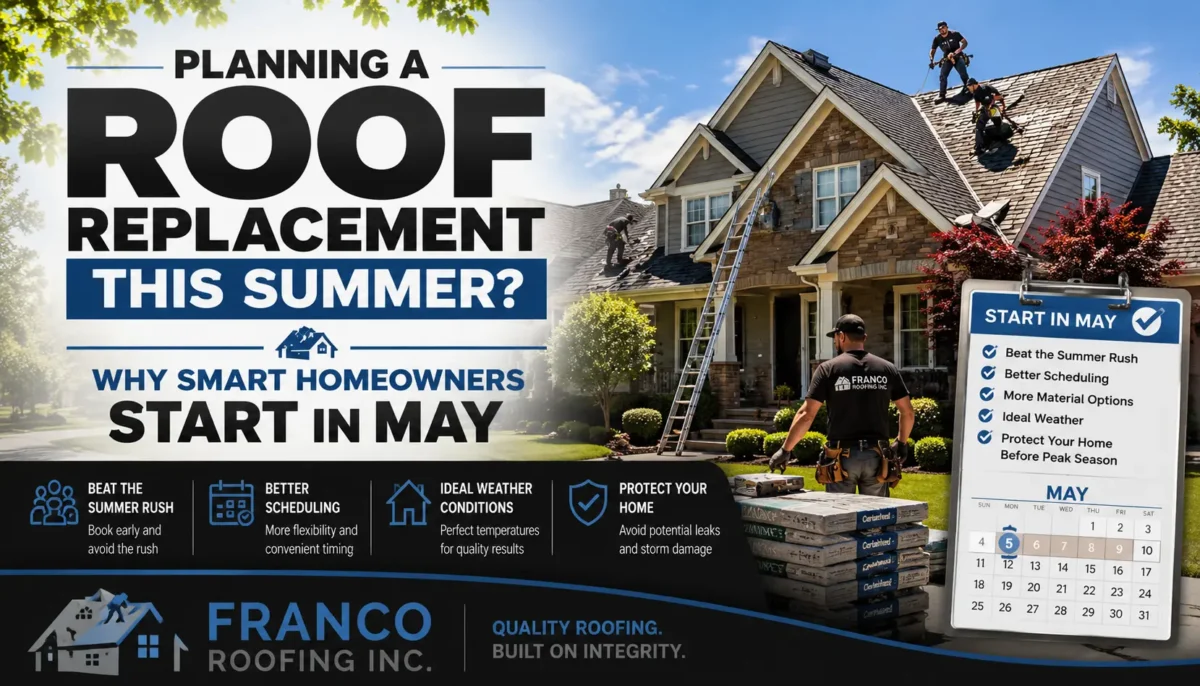
If your roof made it through another Bucks County winter but you know it’s on borrowed time—the shingles are aging, you had a repair last fall, the inspector flagged it, or you’ve simply been living with low-grade anxiety every time it rains—you’re probably thinking about a replacement this summer. That’s a smart instinct. Summer is one of the best times for roof work in Pennsylvania.
Here’s what most homeowners don’t realize until it’s too late: the worst time to start planning a summer roof replacement is summer. By June and July, quality roofing contractors in Bucks County and Montgomery County are booked weeks out. Material lead times for premium products—slate, cedar shake, standing seam metal, and architectural shingles—extend when demand peaks. The homeowners who get the best scheduling, the most attentive project management, and often the most competitive pricing are the ones who started the conversation in May.
This isn’t a sales pitch to create urgency. It’s a straightforward explanation of how roofing contracting actually works in our market—and what it means for homeowners who want the best outcome from a significant investment. Franco Roofing, Inc. has been managing roof replacement projects throughout Bucks County, Montgomery County, and Western New Jersey since 1971. Here’s what 54 years of scheduling, materials procurement, and project delivery has taught us about timing.
What You’ll Learn
- Why summer roof replacements booked in May produce better outcomes than those booked in July
- The real reasons roofing schedules compress in summer—and what that costs homeowners who wait
- How to assess whether your roof genuinely needs replacement vs. repair
- What a well-planned roof replacement process looks like from estimate to completion
- Why Bucks County homeowners choose Franco Roofing for major replacements
- Frequently asked questions about roof replacement timing and costs in Pennsylvania
The Problem: Why Waiting Until Summer to Plan a Summer Roof Replacement Backfires
A roof replacement is one of the largest single investments most Bucks County homeowners make in their property. The average residential replacement in our market runs from $8,000 for basic asphalt on a smaller home to $40,000 or more for premium materials on a larger historic property. At that scale, the quality of the contractor relationship, the care taken in material selection, and the execution of the installation itself all matter enormously.
The problem is that most homeowners approach this investment the way they approach a commodity purchase—contact a few contractors in late June, get quotes, and try to get something scheduled quickly. What they encounter instead: the contractors they want are already committed through August. The materials they’re interested in have a 3-to-4-week lead time that pushes installation to September. And because they’re working under time pressure, they end up settling for a contractor they’re less confident in or a material they weren’t first choice on.
None of this is inevitable. It’s a predictable outcome of starting too late—and it’s entirely avoidable.
Signs your roof may be approaching replacement territory this year:
- Asphalt shingles 20 years or older showing widespread granule loss, curling, or cracking
- Multiple repairs in the last two to three years without a lasting fix
- Contractor recommendation of replacement during a recent inspection or repair visit
- Interior ceiling staining that has returned after previous repairs
- Visible sagging or decking damage identified during attic inspection
- Cedar, slate, or metal roofing that has exceeded its expected service life
- Home sale or major renovation planned for late 2026 or 2027
Why Summer Roofing Schedules Fill Up—and What That Means for Homeowners Who Wait
Understanding what drives summer scheduling pressure helps homeowners make smarter decisions about timing. These are the real dynamics at work in the Bucks County and Montgomery County roofing market every summer.
1. Post-Winter Demand Peaks Simultaneously Across the Region
Every spring, homeowners across Bucks County and Montgomery County discover roofing issues that developed or became apparent over winter. Storm damage from late winter events, deferred projects that homeowners put off through the cold months, and roofs that finally reached the end of their service life all produce a concentrated burst of demand hitting the market at the same time. Quality contractors—who operate with fixed crews and can only take on a set number of projects per month—fill their summer calendars quickly. In our experience, May and early June scheduling conversations consistently result in better project placement than late June or July outreach.
2. Premium Material Lead Times Are Significant
Basic asphalt shingles are generally available on short notice. But the materials that Bucks County and Montgomery County homeowners with premium properties are often interested in—natural slate, synthetic slate composites like EcoStar, cedar shake, standing seam metal panels, and copper—have meaningful lead times that extend further during peak season. Selecting material, confirming availability, and coordinating delivery takes time that homeowners who start in late June simply don’t have. Starting in May means material selection happens without time pressure and without the risk of your preferred product being backordered into fall.
3. Permit and HOA Processing Takes Longer Than Homeowners Expect
Roof replacements in Bucks County townships require permits. Processing times vary by municipality—some townships turn permits around in a week, others take three to four weeks during peak season when building departments are handling a high volume of submissions. Properties in historic districts in Doylestown, New Hope, or Princeton face an additional layer of review through historic preservation commissions, which meet on monthly or bi-monthly schedules. A homeowner who discovers in late June that their replacement needs historic commission approval may find the earliest available review date is in August. Starting in May allows permit and approval processes to run in parallel with material procurement rather than adding sequentially to the timeline.
4. Rushed Projects Invite Shortcuts
When homeowners are working under time pressure—motivated by a leak, an upcoming sale, or a self-imposed summer deadline—they’re more likely to accept the first available contractor rather than the right one. In our 54 years in this business, we’ve seen the consequences of rushed roofing decisions: inadequate underlayment systems, improper flashing installation, mismatched materials, and workmanship that fails before the manufacturer warranty even becomes relevant. A roof replacement done under deadline pressure is a roof replacement with elevated risk. Starting in May removes that pressure entirely.
How to Assess Whether Your Roof Needs Replacement or Repair
Before scheduling anything, the right first step is an honest assessment of what your roof actually needs. Replacement is not always the answer—and a contractor who recommends replacement without a thorough inspection is a contractor to be cautious about. Here’s how to think through the question.
- Know your roof’s age and material. Asphalt shingles have an expected lifespan of 20 to 25 years under normal conditions in Pennsylvania’s climate. Cedar shake runs 30 to 40 years with proper maintenance. Slate, installed correctly, can last 75 to 100 years or more. If your asphalt roof is 18 years old and showing widespread wear, replacement planning is appropriate. If it’s 12 years old with isolated issues, targeted repair is likely the better call.
- Assess how many layers are on the roof. Pennsylvania building codes permit a maximum of two layers of asphalt shingles. If your home already has two layers—which is common on houses that had one re-roof over the original—the next project must be a full tear-off replacement regardless of the current layer’s condition. Your contractor should identify this during inspection.
- Evaluate the decking condition. A roof replacement that installs new material over compromised decking is a replacement that will underperform from day one. Have a professional assess decking condition during the inspection—soft spots, water staining, and rot need to be addressed as part of the replacement scope, not left underneath new shingles.
- Consider the repair-versus-replace calculus. A useful rule of thumb: if repair costs exceed 30 to 40 percent of full replacement cost, and the roof is in the second half of its expected lifespan, replacement typically makes more financial sense. Stacking repairs on a roof that’s approaching end-of-life defers the inevitable while spending money that doesn’t extend the roof’s life proportionally.
- Get a professional assessment from a specialist. The most reliable input on this decision comes from a roofing contractor who has no stake in recommending replacement over repair when repair is appropriate. Franco Roofing’s 80% referral-based business model means our reputation depends on honest recommendations. If repair is the right answer for your roof, we’ll tell you that.
What a Well-Planned Roof Replacement Looks Like: Franco Roofing’s Process
For homeowners who determine that replacement is the right path, here’s what the process looks like when it’s properly planned with adequate lead time.
Step 1: Free Consultation and Thorough Assessment (May)
Michael Procaccino or a Franco Roofing specialist visits the property for a hands-on inspection covering the full roofing system—shingles, underlayment, decking, flashing, ventilation, and all penetration points. We assess what’s there, what needs to go, and what the decking beneath will require. We discuss material options appropriate for the home’s architecture, your performance expectations, and your budget. This conversation takes the time it deserves.
Step 2: Detailed Written Proposal and Material Selection (May–Early June)
You receive a comprehensive written estimate with line-item detail covering tear-off, decking repair allowance, underlayment system, material, flashing, ventilation, and final cleanup. No hidden fees, no vague allowances that expand at billing time. We walk through material options—manufacturer, product line, color, and warranty—with enough time to make a considered choice rather than a pressured one. For premium materials including EcoStar synthetic slate, natural slate, and cedar shake, material is confirmed and ordered with adequate lead time to hit the target installation window.
Step 3: Permitting and Historic Review (May–June, Running in Parallel)
Franco Roofing handles permit applications across all Bucks County and Montgomery County municipalities. For properties in historic districts—Doylestown, New Hope, Newtown, Princeton—we manage the historic commission submission process and can advise on material selection to support approval. Starting in May means permit processing runs in parallel with material lead time rather than adding to the total timeline.
Step 4: Professional Installation by Franco’s Specialized Team (June–August)
Our team of 10 specialized installers—employees, not subcontractors—executes the installation. Most residential asphalt replacements are completed in one to three days. Slate and cedar projects typically run one to two weeks. We manage the project timeline directly and maintain communication throughout. Your property is left clean at the end of each workday and fully cleaned at project completion.
Step 5: Final Walk-Through and 10-Year Warranty Documentation
Every Franco Roofing installation is closed with a final inspection and walk-through. You receive documentation of your 10-year workmanship warranty and applicable manufacturer material warranties—ranging from 25 years on architectural asphalt shingles to lifetime coverage on select premium products. This is the paperwork that protects your investment and travels with the home if you sell.
Why Bucks County Homeowners Choose Franco Roofing for Major Replacements
A roof replacement is not a transaction—it’s a project that requires a contractor relationship built on trust, expertise, and accountability. Franco Roofing, Inc. has been that contractor for Bucks County and Montgomery County homeowners since 1971. Our second-generation family business—founded by Franco Procaccino and continued by his son Michael, who brings 25+ years of direct installation and project management experience—has built an 80% referral-based business by delivering quality that holds up over time.
Our signature specialties—slate, cedar shake, and standing seam metal—set us apart from general contractors who do roofing as one of many services. When a New Hope homeowner with a 1910 Victorian needs a natural slate replacement that matches the historic character of the property, or a Doylestown family wants a synthetic slate system that performs like real slate at a more accessible price point, this is the work we’ve spent 54 years perfecting.
We are fully licensed in Pennsylvania (PA #PA018056) and New Jersey (NJ #13VH07058000), carry a $2,000,000 general liability policy and workers’ compensation coverage, and are certified installers for CertainTeed, GAF, Tamko, EcoStar, and James Hardie. Every installation is backed by our 10-year workmanship warranty on top of manufacturer coverage.
Our low-overhead business model—built on referrals rather than advertising—means our pricing is competitive without the markups that come with high marketing spend. The savings go to the homeowner, not to a lead-generation platform.
Frequently Asked Questions
How much does a roof replacement cost in Bucks County?
Cost varies significantly based on roof size, pitch, material choice, decking condition, and whether tear-off of existing layers is required. Basic architectural asphalt shingle replacements on a mid-size Bucks County home typically start in the $8,000 to $14,000 range. Premium materials—slate, cedar shake, standing seam metal—run $18,000 to $40,000 or more depending on scope. Franco Roofing provides free, detailed written estimates with full line-item transparency. There are no vague allowances that expand at billing time.
How long does a roof replacement take in Pennsylvania?
Most residential asphalt shingle replacements are completed in one to three days. Cedar shake projects typically take one to two weeks due to the specialized installation process. Natural slate projects run one to two weeks depending on roof complexity. Standing seam metal installations generally take three to five days. We provide specific timeline estimates during the consultation, and those estimates reflect our actual scheduling—not optimistic projections.
Is summer actually the best time for a roof replacement in Pennsylvania?
Late spring through early fall is the ideal installation window for most roofing materials in Pennsylvania. Consistent temperatures allow proper shingle sealing and adhesive curing. Dry weather reduces installation interruptions. The key is starting the planning process in May so installation slots and materials are secured before the peak summer rush. Homeowners who start planning in May can typically schedule installation for June, July, or August on their preferred timeline rather than fitting into whatever slot remains.
Do I need a permit for a roof replacement in Bucks County?
Yes, most Bucks County and Montgomery County municipalities require permits for roof replacements. Requirements and processing times vary by township. Properties in historic districts—Doylestown, New Hope, Newtown, and others—may also require historic commission review of material selection. Franco Roofing handles the full permitting process as part of every replacement project, including historic submissions where applicable.
Should I repair or replace my roof?
The honest answer depends on the roof’s age, the extent of damage, the condition of the decking, and repair cost relative to replacement cost. If your asphalt roof is under 15 years old with isolated damage, repair is likely appropriate. If it’s 20-plus years old with widespread wear or you’ve repaired it multiple times, replacement is usually the better investment. A professional inspection gives you the information to make this decision—which is exactly what Franco Roofing’s free consultation is designed to provide.
What roofing materials does Franco Roofing install for replacements?
Franco Roofing installs the full range of residential roofing materials: architectural and 3-tab asphalt shingles, natural slate, synthetic slate composites (EcoStar, Inspire), cedar shake and cedar shingles, standing seam metal, copper, flat roofing systems (EPDM, TPO, modified bitumen), and Spanish tile. Slate and cedar are our signature specialties with 50-plus years of dedicated expertise. We can discuss the performance, appearance, and cost profile of each option during consultation.
Does Franco Roofing offer financing for roof replacements?
Yes, financing options are available for qualified homeowners. We accept cash, check, and credit card, and financing is available through our lending partners for those who prefer to spread the investment over time. Ask about financing options during your consultation.
Next Steps: Start the Conversation in May
If you’re thinking about a roof replacement this summer, the single most valuable thing you can do for your timeline, your material options, and your peace of mind is to schedule a consultation now. The homeowners who contact us in May are the ones who get the summer installation window they want, the material they actually prefer, and the full attention of a contractor who isn’t juggling a backlog.
Key takeaways:
- Quality contractors in Bucks County and Montgomery County fill summer schedules in May and early June
- Premium materials have lead times that require early ordering to hit summer installation windows
- Permits and historic commission reviews take time that needs to run in parallel, not sequentially
- Starting in May eliminates time pressure and produces better decisions throughout the process
Contact Franco Roofing, Inc. for a free, no-obligation consultation:
- Doylestown: (215) 345-1828
- Newtown: (215) 860-1550
- Pipersville: (215) 766-0266
- Email: francoroofinginc@verizon.net
- Website: francoroofinginc.com
We respond within 24 hours and can typically schedule consultations within one week. Serving Bucks County, Montgomery County, and Western New Jersey since 1971.